
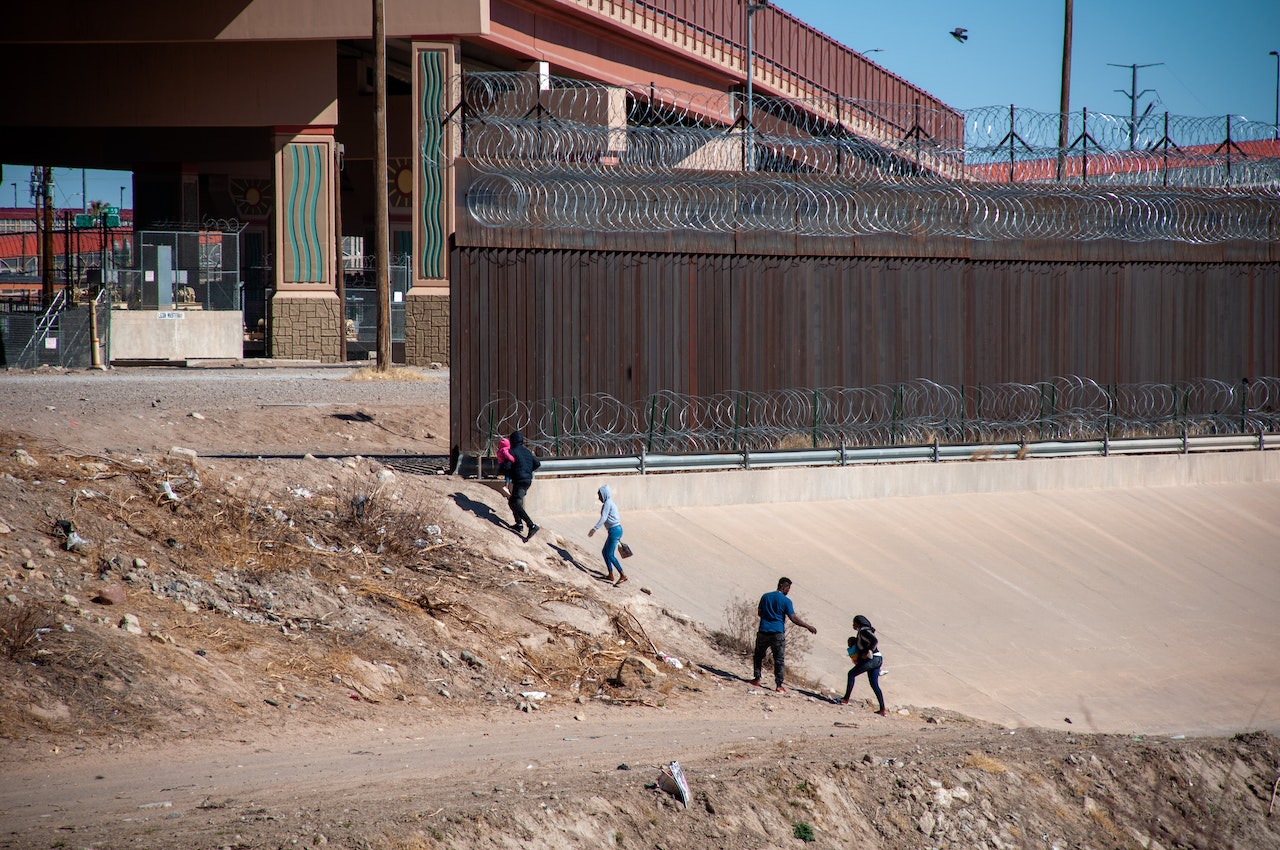
RESEARCH ARTICLE Crossing the immigration and race border: A critical race theory approach to immigration studies Mary Romero* School of Justice and Social Inquiry, Arizona State University, Tempe, USA In this essay I discuss the conceptual and practical benefits of employing critical race theory to the field of immigration studies. It is widely acknowledged, and regrettable, that sociological research on immigration has not departed much from its original conceptual beginnings established by the Chicago School of Sociology during the 1920s and 1930s. The Chicago sociologists distinguished between newly arrived ‘immigrants’ and their children, who were identified as ‘ethnic groups.’ Research questions are still being developed that rely on the Chicagoans’ theoretical categories of race, ethnicity, and immigration – categories that are treated as being mutually exclusive. While researchers focusing on the globalization of immigration have now formulated new analyses of race, social exclusion, and social inequality, research on immigration to the United States remains confined to questions concerning assimilation, acculturation, generational conflict, and social mobility. It is unfortunate that mainstream sociological research has completely ignored the groundbreaking work of critical race theory (CRT), which addresses more relevant issues, such as racial profiling, antiimmigration sentiment, the increased militarization of the US–Mexico border, and the high number of immigrant deaths on the border. As such, CRT has much to offer sociologists in their work on immigration.
Contemporary 10.1080/10282580701850371 GCJR_A_285185.sgm 1028-2580 Original Taylor 102008 11 Mary.Romero@asu.edu MaryRomero 00000March and & Article Francis (print)/1477-2248 Francis 2008 Justice Ltd LtdReview(online)
Introduction Largely in response to the civil rights movement of the 1960s and 1970s, scholarship in the sociology of race abandoned the conceptual framework of Robert E. Park, Ernest W. Burgess, and others who, during the 1920 and 1930s, had developed urban sociology at the University of Chicago. Using the city of Chicago as a ‘natural laboratory’ for conducting urban social research, members of the Chicago School (Park, 1922; Park, Burgess, McKenzie, & Wirth, 1925; Thomas & Znaniecki, 1958; Wirth, 1956) focused their work on immigrants who settled in locales that recruited their labor. Adopting Simmel’s social type of ‘the stranger’ as a heuristic in their detached role as researchers, they studied immigrant populations moving into Chicago’s ‘natural areas.’ Building on theories of social organization and conflict, Park and Burgess described immigrants’ social experiences as being those of competition, conflict, or accommodation. Indeed, they saw these experiences as steps toward the inevitable process of assimilation. One of the first major critiques of the Chicago School’s theoretical framework on immigration was made by Blauner (1972), who criticized: (1) its failure to recognize that race and ethnic groups persist as central entities in modern society; (2) its reduction of racism and racial oppression to economic, psychological, and other determining factors; (3) its focus on White prejudice while ignoring structural and institutional racism; and (4) its blanket application of the analogy *Email: mary.romero@asu.edu ISSN 1028-2580 print/ISSN 1477-2248 online © 2008 Taylor & Francis DOI: 10.1080/10282580701850371 http://www.informaworld.com
Read the Full Article
Cite This Work
Mary Romero (2008). Crossing the Immigration and Race Border: A Critical Race Theory Approach to Immigration Studies. Contemporary Justice Review, 11(1).


