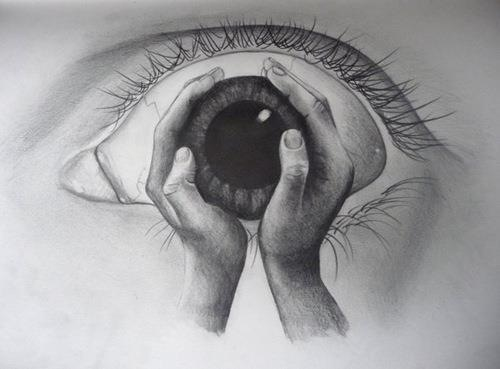
Blind Spots: Thoughts for Visual Sociology
Upon Reading Martin Jay’s
Downcast Eyes: The Denigration of Vision
in Twentieth-Century French Thought
Reviewed by Eric Margolis
Associate Professor
Educational Leadership and Policy Studies
Arizona State University
margolis@asu.edu
Ranging from Plato to Lyotard, Jay’s remarkable book is a 600 page introduction to the role of vision in western thought focusing on 20th century French philosophy. Among many other themes, the investigation chronicles the systematic interrogation of visible evidence and the disinterested observer that is the ground of every social science. Jay is the perfect guide. While admitting an affinity to the Enlightenment “ideal of illumination,” and recognizing the distancing and pitfalls of the totalizing gaze, (17-18) Jay remains agnostic, neither worshiping nor denigrating vision, but like Dante’s Virgil, he makes it clear to readers that the only path is to go through hell itself.[Note 1] He examines writers, artists and thinkers who doubt the centrality and trustworthiness of vision: “French thought in a wide variety of fields is in one way or another imbued with a profound suspicion of vision and its hegemonic role in the modern era” (14). Yet, in the end, Jay concluded that “…it cannot be denied that for all its hyperbolic rhetoric, for all its inclination to demonize, the antiocularcentric discourse has successfully posed substantial and troubling questions about the status of visuality in the dominant cultural traditions of the west” (589). In my reading of Jay’s book I will try to address some of the questions that are most troubling for visual sociologists. We visualistas, sociologists who look the world straight in the face, who gather it as data with our eyes and cameras, have a lot to learn from those for whom seeing is not believing, who are not from Missouri, who denegrate vision and view the world through downcast eyes. In approaching Jay’s book through the eyes of a visual sociologist I will look specifically at four themes raised repeatedly in this history of ideas: The centrality of vision, looking at and being looked at by others, surveillance, and photography.[Note 2] At the end I’ll briefly consider the image world

I. The Dominant Scoptic Regime
Over hearing, touch or smell, western thought has privileged vision at least since Plato’s cave allegory. In his chapter called “The Noblest of the Senses,” Jay develops the point made by Hans Jonas “that the externality of sight allows the observer to avoid direct engagement with the object of his gaze. Thus the very distinction between subject and object and the belief in the neutral apprehension of the latter by the former, a distinction so crucial for much later thought, was abetted by the ocularcentrism of Greek thought” (25). Vision further wormed its way into the heart of “objective” science as it came to be modeled after the passive Copernican contemplation of the night sky; but it was Descartes who enthroned vision as the master sense in Western thought. In describing the journeys he undertook in preparation for his philosophical investigations, Descartes ?(1637 [1960]:22)wrote that for nine years “I wandered here and there throughout the world, trying everywhere to be spectator rather than actor in all the comedies that go on.” He further proposed that the attitude of the spectator was ethically neutral: “the mental process of knowing a thing is good or bad is distinct from, and can occur without, the mental process of knowing that we know it” (Descartes 1637 [1960]:19). Anticipating the gaze of street photographers like Eugène Atget or Helen Levitt, Descartes adopted the modern attitude of the Flâneur or, for our purposes, the disinterested observer. This stance underpins much of sociology in general and visual sociology in particular.?
Jay embellished the first chapter with a Cartesian epigraph celebrating vision and further supporting those of us who favor cameras in social research:
All the management of our lives depends on the senses, and since that of sight is the most comprehensive and noblest of these, there is no doubt that the inventions which serve to augment its power are among the most useful that there can be. (21)
In one of three treatises appended to the Discourse on Method, La Dioptrique (1637), Descartes set out views on vision which, as Jay noted, laid the ground for the modern “visualist paradigm:”?
…[Descartes] tacitly adopted the position of a perspectivalist painter using a camera obscura to reproduce the observed world. “Cartesian perspectivalism,” in fact, may nicely serve as a shorthand way to characterize the dominant scoptic regime of the modern era (69-70).
The Cartesian mind/body duality relates consciousness to matter as if a deduction machine in our head was gazing through a window on the world. Jay quoted Richard Rorty’s contention in Philosophy and the Mirror of Nature that:
In the Cartesian model, the intellect inspects entities modeled on retinal images…. In Descartes conception – the one that became the basis for modern epistemology – it is representations which are in the “mind” (70).
There are two consequences to Cartesian perspectivalism. One is what Jay termed the “modern epistemological habit of ‘seeing’ ideas in the mind” (70). Descartes did not imagine ideas to be mere sensory reflections of the material world; in his famous epoché, it was the reasoning process not empirical evidence that he found undoubtable (73). The other consequence, of particular importance to visual sociologists, is the “legitimating mode of scientific investigation through visual observation of evidence (from the Latin videre)…” (70-71). Going back to the Greeks, Jay noted the identification of the mind’s eye with “speculation” and binocular vision of two eyes with “observation” (29). As visual sociologists we thus engage in a distinctly Cartesian project; treating the visually observed world (including photographs and other representations facilitated by instrumentation) as empirical evidence from which we deduce such mental constructs as social relationships and speculate on their meaning. Prefiguring some of the discussions in semiotics, Descartes’ Optics opened yet another window for the visual sociological imagination:?
We should consider that there are many other things besides pictures which can stimulate our thought, such as, for example, signs and words, which do not in any way resemble the things which they signify …. There are no images that must resemble in every way the objects they represent – for otherwise there would be no distinction between the object and its image – but that it is sufficient for them to resemble the objects in but a few ways (75-76 quoting Descartes, Optics).
As Jay explained, “Images in the mind were thus perceptual judgments, not mere simulacra. They involved the intervention of language to read them correctly” (79). Nonetheless, in his search for a guarantor of truth, Descartes rejected popular belief, custom, the “testimony of the majority,” and the wisdom of the ancients refusing, as Jay put it, “the voices of the past and trusting instead only to what one could ‘see with one’s eyes.’” The bulk of Downcast Eyes consists of Jay brilliantly guiding the reader through the variety of criticism’s of the dominant scoptic regime. As he noted, this critique was not restricted to Descartes: “Insofar as the Enlightenment was premised largely on that same attitude, the antiocularcentric discourse often took on a self-consciously Counter-Enlightenment tone” (82). The territory Jay covers is encyclopedic, in one of his comprehensive summaries he lists the following critics of ocularcentrism:
Bergson’s critique of the spatialization of time, Bataille’s celebration of the blinding sun and the acephalic body, Breton’s ultimate disenchantment with the savage eye, Sartre’s depiction of the sadomasochism of the “look,” Merleau-Ponty’s diminished faith in a new ontology of vision, Lacan’s disparagement of the ego produced by the mirror stage, Althusser’s appropriation of Lacan for a Marxist theory of ideology, Foucault’s strictures against the medical gaze and panoptic surveillance, Debord’s critique of the society of the spectacle, Barthes’s linkage of photography and death, Metz’s excoriation of the scopic regime of the cinema, Derrida’s double reading of the specular tradition of philosophy and the white mythology, Irigaray’s outrage at the privileging of the visual in patriarchy, Levinas’s claim that ethics is thwarted by a visually based ontology, and Lyotard’s identification of postmodernism with the sublime foreclosure of the visual… (588)
All this hostile terrain is not necessarily of equal interest to visual sociologists. To my way of thinking one of the most telling attacks on Cartesian perspectivalism is what Sartre termed “the look.” Let me briefly examine four issues: Sartre’s statement of the look in Being and Nothingness that Jay castigated as a “paranoid ontology of the gaze” (408), an alternate formulation of Le Regard associated with Merleau-Ponty, the feminist argument that the gaze is male, and the oddly compelling notion that the eye projects emotional meaning.?
Here’s Looking at You:
We become conscious of another’s subjectivity when we become aware of them looking at us and conversely we feel our selves as object in the same instant. We want to be in control, we want others to exist for us, but when we observe that we are fixed in the other’s gaze we become aware that we exist for them; that we are an object for them. We experience the other’s look as an attack on our freedom because it is an alien point of view over which we have no control. Thus Sartre wrote: “To be looked at is to apprehend oneself as the unknown object of unknowable appraisals – in particular, of value judgements. … Those subjective reactions to the Other’s look (include) fear (the feeling of being in danger before the Other’s freedom), pride, or shame (the feeling of being finally what I am but elsewhere, over there for the Other, the recognition of my slavery (the feeling of the alienation of all my possibilities)” (Sartre 1943 [1971]:358). Sartre thus denied Descartes formulation that knowing could be non-judgmental and that it was possible to avoid complicity or maintain the “clean hands” of the disinterested observer (284). For Sartre (1943 [1971]:358): “A judgment is the transcendental act of a free being.” In Jay’s summary “the Cartesian self-reflecting cogito is replaced by a self that is constituted by the gaze of the other” (288). [Note 3] When two subjectivities encounter one another, then, the look is a duel similar to the conflict expressed in English as being “eyeball to eyeball.” The loser is the one who “blinks,” thus, in an instant, turned into an object for the other. Dogs and people know the stare as an aggressive act.

Jay is correct as far as he goes, but I think that his discussion of Sartre’s ontology was weakened by the failure to include in his account Sartre’s use of the plural subject “we” which can be traced from Being and Nothingness through the Critique of Dialectical Reason:
In the “we,” nobody is the object. The “we” includes a plurality of subjectivities which recognize one another as subjectivities. Nevertheless this recognition is not the object of an explicit thesis; what is explicitly posited is a common action or the object of a common perception. “We” resist, “we” advance to the attack, “we” condemn the guilty, “we” look at this or that spectacle. Thus the recognition of subjectivities is analogous to the self recognition of the non-thetic consciousness. More precisely it must be effected laterally by a non-thetic consciousness whose thetic object is this or that spectacle in the world (Sartre 1943 [1971]:535).?
Sartre described the epistemological ground for “we projects” accomplished not by staring at each other, which becomes the game of mirrors, but by being co-intent on the world. We recognize each other’s subjectivity as we work matter together. In the Critique of Dialectical Reason, Sartre ([1960] 1968:351ff.) wrote a chapter on the storming of the Bastille that develops the we project into social “groups in fusion” in which “an injury to one is an injury to all.” This is a far more open and hopeful possibility than Jay’s slogan “paranoid ontology of the gaze” suggests.?
Admittedly this is pretty esoteric stuff. It has however a number of consequences for visual sociologists. Despite the fact that, as Jay put it, “we are beings to be looked at” (359), visual sociologist’s tend not to include themselves in the frame. [Note 4] This practice is similar to, and just as curious as, the general practice in writing up qualitative research and editing out the questions. It is common to include one’s “questionnaire” as an appendix, a far different effect than including the actual words that provoked the quoted response. Similarly, we often present photos of our subjects as if they occurred sui generis and the observer was not there.? [Note 5] This might be an act of omission, of denial, or a form of aggression.? We might consider what it means not to stare directly at the other but to cultivate peripheral vision; to focus on things or spectacles in the world alongside the other so that a we project might emerge. Some of Doug Harper’s (1987) photos in Working Knowledge come close to realizing this possibility. A we project is accomplished as Willie shows Doug (and the camera) how he cuts, shapes, bends and welds metal.
Regards, Maurice Merleau-Ponty
Jay observed that the word “regard” has two meanings; in both English and French it means to look at but also to care for. The second meaning was highlighted by Merleau-Ponty who disagreed with Sartre on this point and “more optimistically posited a cooperative, complementary world of intersubjectivity in which mutual regard is a visual as well as emotional phenomena” (312). Merleau-Ponty rejected classical schools of perception which he classified as “empiricist” or “intellectualist:”
… empiricism because it turned the subject into an object in the world like all others, intellectualism because it made the cognitive subject all-powerful, turning perception into a mere function of thought, an effect of judgment. In both cases the world was. construed as a spectacle to be observed from afar by a disembodied mind (308).
In opposition Merleau-Ponty posited “being in the world ” to, as Jay contended, “mingle the viewer with the world on view” (309). “Wild Being, the flesh of the world, thus became the fundamental category for Merleau-Ponty, grounding both subject and object, viewer and viewed, mind and body” (319). [Note 6] Jay contended that, Merleau-Ponty confronted the Sartrean ossifying look with language:
“What is it like when one of the others turns upon me, meets my gaze, and fastens his own upon my body and my face?” His answer was that “unless we have recourse to the ruse of speech, putting a common domain of thoughts between us and a third party, the experience is intolerable. There is nothing left to look at but a look. Seer and seen are exactly interchangeable. The two glances are immobilized upon one another . . . . Vision produces what reflection will never understand – a combat which at times has no victor …. Speech . . . would interrupt this fascination” (324).
Merleau-Ponty was nonetheless critical of vision and the Cartesian project. If indeed language makes perception intelligible then there can be no Cartesian or Sartrean subject constituted by the eye or the look alone. But language’s relation to perception is ambivalent; it may add to perception; it can contradict it as well. Jay quoted Merleau-Ponty’s position in The Visible and the Invisible:
“… there is all the same this difference between perception and language, that I see the perceived things and that the significations on the contrary are invisible. The natural being is at rest in itself, my look can stop on it. The Being whose home is language cannot be fixed, looked at” (324).
This point was further elucidated by Emmanuel Levinas who quipped “Even when he does not regard me, he regards me” (543). Levinas argued that: “the two meanings of “regard” should therefore be rigorously separated, for to care for the Other meant refusing to turn him or her into an object of visual knowledge or aesthetic contemplation” (556). The relation of language and visual perception might be recognized as the essential ground for a visual sociology seeking to unify the senses rather than privileging vision over other sources of information about the world. The invisible meanings – concept, social relationship, ideology, and so on that exist solely as language – cannot be dispensed with. Although we use images in our texts, words flow all around them. It is curious to me that so many visual sociologies, especially visual ethnographies, documentaries, and photo elicitation studies are as much aural as visual. We talk to people, quote them at length, and together with them explicitly seek the visible and invisible in the “flesh of the world.” This can be the very essence of Sartre’s concept of the “we project,” yet we endlessly call for respect as visual sociologists not aural sociologists or “whole body” sociologists. [Note 7] If sight is “othering,” if words bring us to community, if we intend our “regard” of the other to mean “care for,” then I think we do not pay nearly enough attention to the talk that fills pages between photographs.
A central question raised by Merleau-Ponty and by Martin Jay is: How do visual sociologists regard our subjects? Is our regard the medusan look that petrifies and objectifies, or the regard that “cares for”? Be careful! There is no easy answer despite every researcher’s knee-jerk reaction of identification and sympathy with their subjects. Once we manufacture and present an image of the other, and despite the blizzard of words we offer in support of this or that sympathetic reading, we cannot control the gaze of the viewer. We must heed Levinas’s warning about not turning our subjects into “the objects of visual knowledge.” As Sartre wrote in a broader discussion of language:
…the “meaning” of my expressions always escapes me.?I never know exactly if I signify what I wish to signify nor even if I am signifying anything. … Thus the word is sacred when I employ it and magic when the Other hears it. Thus I do not know my language any more than I know my body for the Other. I cannot hear myself speak nor see myself smile (Sartre 1943 [1971]:486,487).

What is true for words is doubly true for images. We cannot control how others see the images we produce or highlight. To the extent that sociology is part of the dominant perspectivialist regime it transfixes the Other as an insect on a pin. Moreover, we don’t know how we look when we are looking, that is how we are regarded. Visual sociologists typically look and are not looked at. As we’ll investigate later in discussing photography; motion, sound, history are stopped, objectified. Whether we love our subjects or not, the act of writing about them and showing their images is objectifying. That is the epistemological problem; there is a related political problem.?
Despite our regards, or perhaps because of them, we overwhelmingly look down. [Note 8] In a quick and dirty review of past issues of Visual Sociology/Visual Studies I found no one looking on the level examining professors, students, or university life, the mall, suburbia – although I’ll warrant most visual sociologists spend their lives in these places. Apparently we don’t look up either – where are the visual sociologies of the life styles of the rich and powerful? Where is the C. Wright Mills of visual sociology? Our pages seem overwhelmingly to be illustrated with working class cultures and exotic others: Samoans, Asylums, Palestinians, African Americans, Sports Fans, Coal miners, Demonstrators, Farmers in Cape Breton in the 1950’s, Swiss farmers in the 1940’s, Advertising images of sexuality, gender, and race, Black Stereotypes, Tattoos, Homeless persons in various urban and rural settings, Motorcycle riders, Drag queens, and the like. These are people who cannot resist our gaze. Visual sociology seems, perhaps inadvertently, to be reproducing the dominant scoptic regime that so clearly differentiates subject from object.
Flâneur or Voyeur?
The crowd is his element, as the air is that of birds and water of fishes. His passion and his profession are to become one? flesh with the crowd. For the perfect flâneur, for the passionate spectator, it is an immense joy to set up house in the heart of the multitude, amid the ebb and flow of movement, in the midst of the fugitive and the infinite. To be away from home and yet to feel oneself everywhere at home; to see the world, to be at the centre of the world, and yet to remain hidden from the world – impartial natures which the tongue can but clumsily define. The spectator is a prince who everywhere rejoices in his incognito. (Baudelaire [1863] 1964).

The crowd is his element, as the air is that of birds and water of fishBaudelaire’s description of the flâneur captures many of the qualities of the ethnographic stance. One of the most telling criticism’s of the dominant view of observation as a non-judgmental, disinterested activity forces us to recognize that looking is pleasurable even lustful. There is a pornography of the gaze stemming, in some accounts, from Freud who, as Jay informed us, “came to believe that the very desire to know (Wisstrieb), rather than being innocent, was itself ultimately derived from an infantile desire to see, which had sexual origins” (332). As Jay also noted: “Bryson goes so far as to claim that ‘the life of vision is one of endless wanderlust, and in its carnal form the eye is nothing but desire.’ It was, however, by and large the decarnalized eye that characterized the Cartesian perspectivalist scopic regime” (166). Many antiocularcentric writers, especially Georges Bataille, emphasized, not the nobility of vision but its involvement with base desire. For French feminists ocularcentrism was phallocentrism (526). I first encountered the curious relationship between the eye and the phallus in the early 1970’s in a talk by Norman O. Brown in which he deconstructed the Greek myth of Actaeon [Note 9] who, you’ll recall, was out hunting and peeked at Diana as she bathed naked. She splashed water in his face; horns grew where his eyes had been and he was hunted down by his own dogs and torn to pieces. Tracing the myth through history, Brown made much of horny eyes: “Caught in a thicket by his horns, the cornea of his eyes. Some interpret the gates of horn as the eyes, taking the part for the whole, in that the outermost covering of the eye is horny” (Brown, 1991:40)..es. His passion and his profession are to become one? flesh with the crowd. For the perfect flâneur, for the passionate spectator, it is an immense joy to set up house in the heart of the multitude, amid the ebb and flow of movement, in the midst of the fugitive and the infinite. To be away from home and yet to feel oneself everywhere at home; to see the world, to be at the centre of the world, and yet to remain hidden from the world – impartial natures which the tongue can but clumsily define. The spectator is a prince who everywhere rejoices in his incognito. (Baudelaire [1863] 1964).
Actaeon; alien horns added to his forehead; the dogs that sated themselves in the blood of their own master; all for the sin of seeing. Cur aliquid vidi? ?Why did I have to see something? (Brown 1991:31)
Lust and remorse are as much a part of seeing as clarity and objectivity. Jay noted that after 1968 French feminists turned to the investigation of how vision contributed to patriarchal domination, adding deeply to the attack on ocularcentrism:
For as Alice Jardine has remarked, in France, “woman” or “the feminine” has not only been a metaphor for a certain kind of reading and writing, but also “a tool for declaring war on the Image within the more general twentieth-century iconoclastic imagination” (528).
For Irigaray the gaze was male and as impersonal and threatening as Sartre’s look (538); but the intertwined questions of visual pleasure and whether the gaze was male intrigued many feminist theorists including Teresa de Lauretis and Laura Mulvey on moving pictures, and Abigail Solomon-Godeau’s examination of photography. For our purposes as visual sociologists, the issue is probably not Lacanian or Freudian notions of castration complexes or even the linguistic similarity of horns and cornea. We need to confront two issues: the first, scopophilia/scopophobia, asks us to consider the pleasures and terrors of seeing: Why do visual sociologists like to look? What do we like to look at? What are we afraid to look at? What is the role of desire in the work of visual sociology? Does visual sociology manifest a desire to penetrate to the core of society? Do we enjoy the Flâneur’s search for secret places? Are we attracted to glossy surfaces? Are there things we are afraid to see? I am not sure visual sociologists ask themselves often enough or deeply enough why we like to look. Once the issue of dispassionate social science has been debunked with the recognition that like everyone visual sociologists have dirty eyes, a second issue arises. It all too clear that the gaze of visual sociology cannot be raceless, genderless, classless. Jay quoted Sartre from Black Orpheus on the gaze of the white man and at the white man:

I want you to feel, as I, the sensation of being seen. For the white man has enjoyed for three thousand years the privilege of seeing without being seen. It was a seeing pure and uncomplicated; the light of his eyes drew all things from their primeval darkness. The whiteness of his skin was a further aspect of vision, a light condensed. The white man, white because he was a man, white like the day, white as truth is white, white like virtue, lighted like a torch all creation; he unfolded the essence, secret and white, of existence. Today, these black men have fixed their gaze upon us and our gaze is thrown back into our eyes …. By this steady and corrosive gaze, we are picked to the bone (294).
Not only are there male and female gazes, gay and straight gazes, and Black and White gazes. There are political gazes, aesthetic gazes, artistic gazes, ethnographic and positivist gazes and so on.? Does visual sociology have a gaze or gazes? The identity, position and stance of the observer central to understanding the work of visual sociologists, is captured in the elegant title to an essay on documentary photography by Abigail Solomon-Godeau, “Who is speaking thus” (1991).

The Evil Eye:
The fourth element of the look, the ability to project a look, anticipates the human ability to read the eyes of the other. Jay described this at length:

For the eye-broadly understood as including the complex of muscles, flesh, and even hair around the eyeball – can clearly project, signal, and emit emotions with remarkable power. Common phrases such as “a piercing or penetrating gaze,” “melting eyes,” “a come-hither look,” or “casting a cold eye” all capture this ability with striking vividness. Aided by its capacity to overflow with the tears necessary to bathe it with constant moisture, a capacity triggered by a multitude of different stimuli, some physical, some emotional (the latter found only in humans), the eye is not only, as the familiar cliches would have it, a “window on the world,” but also a “mirror of the soul.” Even the dilation of the pupil can unintentionally betray an inner state, subtly conveying interest or aversion to the beholder.
There is, moreover, a learned ability to use the eyes to express something deliberately, a skill more sharply honed than in the case of the other senses. Ranging from the casual glance to the fixed glare, the eye can obey the conscious will of the viewer in a way denied the other more passive senses, once again the only competitor being touch with its ability to strangle as well as caress. The phenomenon of the evil eye, mentioned above, is only one manifestation of this potential for sending powerful messages (10).
Many cultures have a concept of the “evil eye,” that (like superman) one can literally project a deadly force with their eyes. More broadly, this quality of the eye helps make it possible for viewers to interpret facial expressions. Interpretation of face value is explicitly or implicitly a requirement of much of visual sociology. Cassius is not the only one with a lean and hungry look. English offers an enormous vocabulary to describe sent gazes: blindly, hooded, bedroom eyes, shameless, guileless, pitiless, askance, veiled, threatening, glassy, dull, bright, darkly, furrowed, suspiciously, sharply, blandly, menacing, looking daggers and so on. Visual sociology relies on the human ability to discern meaning in the gaze of those we observe and portray, but the discipline has not focused on “the look” as of sociological interest. Are the abilities to “read” the look physiological, psychological, or culturally determined? What does age, race, gender, sexuality etc. have to do with giving and receiving eye messages? How do various readers interpret the look?
II.Surveillance
Jay dealt with Jacques Lacan’s contribution to the antiocularist position in great detail. For this discussion I will attend only to a small part of Lacan’s psychoanalytic perspective. For Lacan the eye defined Cartesian perspectivalism.? The gaze locates the subject in “a general perceptual field,” “Caught, manipulated, captured in the field of vision,” as Lacan wrote (364). Lacan thus retained much of Sartre’s concept of the petrifying look, but transformed from the one-on-one relationship into the gaze, the characteristic of a general social field. For example, Jay noted that “In trompe l’oeil painting … the gaze in fact triumphs over the eye” which I take to mean that socially constituted perception easily undermines Descartes’s (1637 [1960]:29) principle that “all those things that which we conceived very clearly and distinctly are true.” The gaze is thus not a quality of the individual other, but of the collective in which, as Jay explained “vision … may be understood as a conflictual field in which the looker is always a body to be observed” (368). In other words, the individual look is here replaced with a social field of vision, a general surveillance that includes everyone.


I doubt there are many sociologists not at least passingly familiar with Jeremy Bentham’s concept of the panopticon prison, so I will not reiterate the architectural description. Sociological interest in the panopticon is usually credited to Foucault’s (1995) essential text Discipline and Punish. [Note 10] Foucault published in 1975 but Jay traced the concept two years earlier, to an essay by Lacan’s son-in-law, a psychiatrist named Jacques-Alain Miller who wrote of the panoptic prison:
This configuration sets up a brutal dissymmetry of visibility. The enclosed space lacks depth; it is spread out and open to a single, solitary central eye. It is bathed in light. Nothing and no one can be hidden inside it – except the gaze itself, the invisible omnivoyeur. Surveillance confiscates the gaze for its own profit, appropriates it, and submits the inmate to it (382).
At the center of the panopticon is nothing less than the ubiquitous watcher, the eye of Mordor, the cameras in Orwell’s 1984. It is simultaneously the fulfillment of social scientific projects of the enlightenment like Comte’s social physics, the Protestant ethic as described by Weber, and Durkheim’s social solidarity – each sought mechanisms to produce a rational and well-ordered society. In Jay’s summary of Miller’s essay, the panopticon:
…struck at the older Enlightenment project of linking reason and illumination. “The Panopticon,” he wrote, “is the temple of reason, a temple luminous and transparent in every sense: first because there are no shadows and nowhere to hide: it is open to constant surveillance by the invisible eye; but also, because totalitarian mastery of the environment excludes everything irrational: no opacity can withstand logic.” Even the jailor is subjected to the controlling gaze of the public, which provides the ultimate moral sanction against deviance from the norm (382).
Foucault’s contribution was to expand the notion of panoptic surveillance into grand social theory. “Our society is not one of spectacle, but of surveillance,” he contended, “We are neither in the amphitheatre, nor on the stage, but in the panoptic machine, invested by its effects of power, which we bring to ourselves since we are part of its mechanism” (Foucault 1995:217) (381):
The object of power is everywhere penetrated by the benevolently sadistic gaze of a diffuse and anonymous power whose actual existence soon becomes superfluous to the process of discipline. The Panopticon, Foucault wrote, is a “machinery that assures dissymmetry, disequilibrium, difference. Consequently, it does not matter who exercises power. Any individual, taken almost at random, can operate the machine” (410).
Foucault’s concern with vision was not solely with the panopticon prison. He had earlier investigated the cool, calculating, therapeutic gaze in The Birth of the Clinic:
The new medical gaze differed from the Cartesian privileging of internal vision at the cost of the actual senses, and rejected its belief in a transcendent, ideal Spectator. Instead, it emphasized the totality of observers, whose “sovereign power of the empirical gaze” played over the solid and opaque surfaces of the body. “No light could now dissolve them in ideal truths; but the gaze directed upon them would, in turn, awaken them and make them stand out against a background of objectivity. The gaze is no longer reductive, it is, rather, that which establishes the individual in his irreducible quality” (393).
“What this individualizing gaze ‘sees,’” argued Jay, is “an epistemic field, constructed as much linguistically as visually” (393). [Note 11] Moreover, this became the mode for all the human sciences (394). Echoing Hegel, Foucault wrote: “man appears in his ambiguous position as an object of knowledge and as subject that knows; enslaved sovereign, observed spectator” (406). The consequence as Jay explained, was that:
the external look becomes an internalized and self-regulating mechanism that extends the old religious preoccupation with the smallest detail that was still immense “in the sight of God.” Although by no means restricted to its ocular dimension, this new mechanism of control was first and foremost a part of the visual economy of the modern world (410).

Foucault’s investigations were deeply concerned with the mechanisms by which human beings have domesticated themselves. Visuality is both a mechanism and a metaphor for the watchfulness by which power insinuated itself throughout the social. Constituting what Jay termed an “epistemic shift,” the projects of humanism were accomplished by replacing “the absent spectator, the king, by the ‘observed spectator,’ Man in a still visually constituted epistemological field” (406). Given that even in its most neo-positivist guise, much of modernist sociology is both humanist and involved with social order maintenance functions, in considering Foucault’s work we need to interrogate the relationship between visual sociology, the therapeutic gaze, and the panopticon. We must even ask if visual sociology might be a gaze of the evil eye: Quoting Lacan, “For the evil eye operates as the fascinum, ‘that which has the effect of arresting movement and, literally killing life” (367). Jay concluded that the evil eye: “emerged from superstition to become the ruling metaphor of social control and political oppression at its most insidious” (378). What we need to consider is not only our intent and practices in individual investigations, but the uses to which others may put our work, and most importantly the aggregate effect of a “visual sociology.”
III. The Pleasures and Dangers of Images
Not all visual sociologists employ cameras, those that do typically proceed from the realist perspective that a photograph is a window on the social world: the world we photograph is objective; it will go on whether we study it or not; and given the coincidence of certain optical and chemical processes, this object world can leave traces on film. This naive realism lurks behind the insistence that visual sociologists use “straight” photography. Our journals are filled with photographs taken at eye level, showing full frame, sharply in focus, well exposed, etc. [Note 12] The camera is assumed to depict what any observer with normal vision would see if they were present at the instant the shutter was released. Only because of this can the camera be considered neutral, a device for gathering visual data from which we then analyze (deduce) certain social patterns and meanings. For the antiocularists, on the other hand, the camera is not simply another instrument to augment the power of sight like the lenses Descartes might have had in mind. Jay quoted Joel Snyder’s (1980) important statement on the difference between sight and photograph:
To begin with, our vision is not formed within a rectangular boundary; it is, per Aristotle, unbounded. Second, even if we were to close one eye and place a rectangular frame of the same dimensions as the original negative at a distance from the eye equal to the focal length of the lens [the so-called distance point of perspective construction] and then look at the field represented in the picture, we would still not see what is shown in the picture. The photograph shows everything in sharp delineation from edge to edge, while our vision, because our eyes are foveate, is sharp only at its “center.” The picture is monochromatic, while most of us see in “natural” color (and there are some critics who maintain that the picture would be less realistic if it were in color). Finally, the photograph shows objects in sharp focus in and across every plane, from the nearest to the farthest. We do not-because we cannot-see things this way (131).
Cameras and photographs add another important layer to Jay’s analysis of the antiocular discourse. There is a voluminous literature on the development, history and meaning of photography; while a large sub-set of that literature denigrates cameras and photographic images, only a small part originated with the French antiocularcentrists. [Note 13] Jay himself, in his earlier study of the Frankfurt School, examined the profound distrust of images in the works of Max Horkheimer, Theodor Adorno, Herbert Marcuse, and Walter Benjamin (Jay [1973] 1996). In that investigation, as in the one under discussion here, Jay traced at least part of the suspicion of photographic images about as far back as one can go in western thought – to the breaking of the tablets, the icon of the golden calf and old testament prohibition of graven images. While not overlooking French anti-Semitism, Jay identified a new interest in Judaism and (re)incorporation of iconoclasm in the antiocular discourse:
An explicitly acknowledged reason for this new fascination with Jewish themes was the importance of the biblical interdiction of graven images. Interestingly, one of the justifications for their hostility advanced by earlier anti-Semitic French intellectuals like Maurice Bardeche and Robert Brasillach was precisely the atomizing effect of the taboo, which they claimed undermined the beneficent power of images in films to create a popular community. Now the reverse implication was drawn, as a multitude of scholars, Jews and Gentiles alike, pondered its wisdom. Literary critics like Jean-Joseph Goux explored the implications of iconoclasm for everything from modern abstract art and the fall of the gold standard to the Nazi persecution of the Jews and the Marxist theory of commodity fetishism. Theologians like the Protestant Jacques Ellul claimed that Christianity properly understood was no less hostile to the primacy of sight than Judaism, and vehemently denounced the current “humiliation of the word” in the society of the spectacle (548).

In surveying French rejections of the image, Jay traverses a wide expanse of obscure terrain: Emmanuel Levinas’s biblical distrust of images, Roland Barthes on photographs, and the image world from Debord’s concept of the spectacle to Baudrilliard’s simulacrum.? Jay commented that: “Bergson set the tone for many who followed with his suspicious disdain for both the snapshot’s violent interruption of the flow of temporal duration and the cinema’s inept attempt to restore its vitality” (436). Once again this review will only skim the surface and try to draw some implications for visual sociology
Roland Barthes, well-known as a semiologist, examined denotative and connotative capacities of photographs. Jay contended that Barthes maintained the denotative/connotative paradigm through all the twists and turns of his remarkable oeuvre. “Connotatively, photos bore an iconic relation to the object represented as, in Barthe’s term, “analogical perfection;” denotatively, they simultaneously existed as signs whose symbolic meaning required cultural capital to decode (442). Barthes wrote that science “interprets the gaze in three (combinable) ways: in terms of information (the gaze informs), in terms of relation (gazes are exchanged), in terms of possession (by the gaze, I touch, I attain, I seize, I am seized): three functions: optical, linguistic, haptic. But the gaze seeks: something, someone. It is an anxious sign: singular dynamics for a sign: its power overflows it” (441). This restlessness was in part addressed in John Berger’s claim that, “In every act of looking there is an expectation of meaning.” (Berger 1982:117). But Jay also noted that “Barthes’s identification of photographic denotation with emotional trauma … provides a clue to … why the seeking gaze produced anxiety (443). Jay suggested that Barthes believed extremely traumatic images could escape the denotative: “trauma is a suspension of language, the blockage of meaning …. One could imagine a kind of law: the more direct the trauma, the more difficult is connotation; or again, the `mythological’ effect of a photograph is inversely proportional to its traumatic effect” (442). The photograph viewer is not conscious of, as Jay wrote:
… the being-there of the thing (which any copy could provoke) but an awareness of its having-been-there. ?What we have is a new space-time category: spatial immediacy and temporal anteriority, the photograph being an illogical conjunction between the here-now and the there-then. The implication of this argument was profound, for now Barthes had uncovered a further source of the anxiety surrounding the photographic image. That is, beyond the fact that the denotative power of photographs was most evident and when they showed explicit traumas, the inevitable aura of a lost past attached to all photographs suggested an implicit trauma as well: the pain associated with mourning that loss (443-444).
This is not about nostalgia. In summarizing Barthes, Jay wrote (Photography) “provides no anamnestic totalization, no means of making history – personal or collective – intelligible. …” Quoting Barthes from Camera Lucida: “The Photograph is violent: not because it shows violent things, but because on each occasion it fills the sight by force, and because in it nothing can be refused or transformed.” Jay concluded that “what precisely cannot be ignored is its message of what Barthes called ‘flat death,’ yielding up no meaning beyond mortality” (455). If photography is necrophilia, if a photograph is memento mori, if, as Barthes famously wrote about posing:
once I feel myself observed by the lens, everything changes: I constitute myself in the process of “posing,” I instantaneously make another body for myself, I transform myself in advance into an image …. I feel that the Photograph creates my body or mortifies it, according to its caprice… The Photograph is the advent of myself as other, a cunning dissociation of consciousness from identity (452).

Then the camera is truly an evil eye accomplishing black magic, transmuting subject to object: “I have become Total-Image, which is to say, Death in person,” wrote Barthes (452). Visual sociologists, I think, intend the opposite. We regard our subjects highly, in fact referring to them as “subjects” not objects. Our goal is for our subjects to “live” through being seen, for their cultures and societies to be brought to life through our exposure. Yet there is something in what Barthes described: there (is) in every photograph the return of the dead” (452). We shoot our subjects, but I do not think we intend to kill – yet people wind up just as dead from friendly fire, or collateral damage. The “flat death” effect seems particularly strong with black and white images. Can our sociological goals be reconciled with Barthes’ (and many others) skeptical view of the photographic process itself? Why are we, ourselves, so rarely in the picture? Perhaps we resist posing because of the gut level resistance to “creating” or “mortifying” our bodies. More precisely, I think that as camera operators, visual sociologists seek to become pure subject to, as Sartre put it, “claim the right of seeing without being seen” (290). There have been several attempts to squirm out of this dilemma, notably the “Shooting Back” series (Hubbard 1991; Hubbard 1994). Whatever the benefits, however, of putting camera’s in the hands of poor children, the practice does not allow escape for the investigator who has removed himself even further from the scene. [Note 14]
Jay observed that “… the invention of the camera can be credited with helping educate Western eyes to new aesthetic possibilities. From another perspective, however, the extension of the range of Western aesthetic experience could be interpreted as an example of the dominating anthropological gaze at the ‘other’” (140). I would argue that, especially in visual sociology’s concern with deviance, the downtrodden, the exotic, our discipline continues to be deeply implicated in both these practices. Part of the problem can be traced to photography itself, straight photography of the mundane familiar patterns of everyday life tends not to be very interesting. It seems difficult to create “new aesthetic possibilities” from the quotidian. Visual sociology has our own version of the well-known problematic of the news media “if it bleeds it leads.” Thus we find a visual study of a dying professor compelling, and don’t have any visual ethnographies of a professor’s life (Pillar 1996).??
In several places in the book Jay described Surrealism’s contribution to antiocular discourse as a counter to realist photography. He noted, for instance that in pictures like “Cici n’est pas une pipe” and “the key of dreams” “Magritte put the visual image on trial, stressing its weakness and demonstrating the subordinate character of figures of speech and thought” (247). In doubting the relationship between signified and signifier, Surrealists contributed their challenge to the “crisis of ocularcentrism” visually (251). “Surrealist photography proved a scandal for what can be called the dominant tradition of “straight photography,” with its assumed spectator still the unified subject of the Cartesian perspectivalist tradition” (253). However, following Simon Watney, Jay concluded that the political project undertaken by the Surrealists to “expose social contradictions” with “estrangement and defamiliarization,” (250) had failed:
(Watney) contends that different contexts of reception have to be taken into account as well, because certain contexts more easily absorb shocks than others. The history of Surrealism’s refunctioning for advertising purposes bears out his warning (250).
“Refunctioning,” of course, is a problem faced by all photography even the realist and earnest tales of visual sociological . Nevertheless, one might easily conclude that some of our downward gaze stems from a similar desire to reveal contradictions and oppositions in society.? Might sociologists use photography to interrogate the social by using less “straight” technique? Shouldn’t we put the visual on trial in our own photography in the same way, for example, that Goffman did in Gender Advertisements (Goffman 1976)?? Given the above criticisms of the visual and photography, some of which are quite trenchant, why does visual sociology remain stuck in the realist mode of Cartesian perspectivalism?? Might not visual sociologists imagine surreal projects, perhaps a visual ethnomethodology using photography to discover and test social rules by violating expectations? The use of doubling and jarring juxtaposition, montage, and so on offer the possibility to reveal truths of social structure and social relations that undergird the surface gloss of realist photography. Perhaps a little more of the disruptive – a la Dianne Arbus or Weegee – would make it seem less like visual sociology inherited the mantle of 1930’s Farm Security Administration documentarians.
IV. Living in the Archive
In much the same way that “the look” morphed into “the gaze” and general concern with a social field of surveillance, the single image exploded into self-referential media worlds of spectacle and simulacrum. There are two crucial questions that stem from the endless multiplication of images in the modern/post-modern era. The first was raised by Guy Debord and Jean Baudrillard: What is the nature of this whatchamacallit media world we have created? The second I will raise for our discipline: The term “visual sociology” suggests a totalization of our various projects; do visual sociologies add up?
For Debord and Baudrillard, humanity has breathed life into a Golum by creating a image world that, while clearly our creation, has taken on a life of its own. Images have torn themselves loose from their referents. Jay used this quotation from Guy Debord as an epigram:
The entire life of societies in which modern conditions of production reign announces itself as an immense accumulation of spectacles. Everything that was directly lived has moved away into a representation (381).
Debord and the Situationist movement that bloomed with the revolutions of 1968, proposed that the modern world of commodity capitalism was no longer experienced directly but only through the mediation of an image world. This world of commodities and representations he called “spectacle”.? In Jay’s summary: “the visible form of the commodity totally occupied everyday life, uniting production and consumption in one monstrous system” (429). Debord’s account drew on both the iconoclastic Christianity of Ludwig Feuerbach (a member of the young Hegelian circle that included Marx and Engels) and from the Marxian analysis of fetishism and reification (426). Like Marx who saw capitalism as a stage in human development, Debord saw spectacle as a product of the commodity fetishism of later stages of capitalism, but held forth the possibility for an unalienated “festival” celebrating human qualities. The hoped for transcendence faded with the hippy-like Situationist movement, and, as Jay noted:
In the 1980s, postmodernist writers like Jean Baudrillard stopped worrying and found a way to accept and even celebrate what Debord and his colleagues had found so troubling: the ubiquity of images without referents and the reification of experience. Baudrillard, who also exhorted his readers to “forget Foucault,” ‘ giddily embraced rather than castigated the “hyperreal simulacrum” of reality. (433)
For Baudrillard, The world is composed of maps that refer to no territory, representations of other representations. He called the world “hyperreal” and “simulacrum” implying copies of copies of copies with no original referent. Photographs refer to photographs; symbols in the system refer only to other symbols. Basic to the discussion of the image world is Baudrillard’s (1983:3) observation that: “Abstraction today is no longer that of the map, the double, the mirror, or the concept. Simulation is no longer that of a territory, a referential being or a substance. It is the generation by models of a real without origin or reality…”
Whatever one’s position on the media world – neutral, good, or ill – it is clear that this is a recent and very important development in the human condition. Jay pointed out the remarkable way the word “image” refers to “graphic, optical, perceptual, mental or verbal phenomena” (8-9). The whatchamacallit becomes more encompassing as all images, visual, aural, and written are reduced to the digital strings of ones and zeros. Music, film, video, talk, text, photographs all are shrunk to an underlying pattern that can be accessed with the flick of a wrist. Moreover, there is no outside for the observer – visual sociology is inside and contributes to the whatchamacallit. We have had a journal since the 1980’s. Our words and photos are bound in books, sedimented in archives and have found their way onto the web, that grand repository of digitized images. We need to consider how visual sociology contributes to spectacle, simulacrum, or whatchamacallit in our imag(ining) of society.
Regards for the Discipline
So, Captain Kirk, is the enterprise doomed? Much of antiocular critique seems harsh, perhaps hyperbolic, simply because there is no way to escape the visual. Certainly there is no reason to abandon visual sociology. But it is also true that everyone is more skeptical of visual images than we were in the 1840’s when the camera was thought to be a “pencil of nature” or a century later when the Roosevelt administration sent photographers to “document” the depression.? Moreover questions once raised cannot be ignored. We have come to a place where we need to ask ourselves how visual sociology looks as a whole. Do the elegant visual ethnographies, life histories and oral histories; the critical studies of images and photographs that unveil propaganda, ideology, stereotype and other “hidden” functions of the image; the panoramic views of social change and urban spaces; the intimate investigations of family photography; our critical and theoretical papers, and so on constitute a whole? Or, does this work exist solely as individual gems to be admired, collected, and shown to students.
Perhaps visual studies are exemplars. I am asking first if visual sociology constitutes a scientific “paradigm” as Kuhn defined it to: “include law, theory, application, and instrumentation together and provide models from which spring coherent traditions of scientific research” (Kuhn 1970:11). We have instrumentation and application, do we have theories to counter or accommodate the antiocular philosophies? Is visual sociology a mere method like interviewing or counting that contributes data to other paradigms – say, Symbolic Interaction or Critical Theory? Do we have a sociological stare to mimic Foucault’s medical gaze? Are we building an application, a language, a spectacle, a simulacrum? Following Foucault, Jay would ask us to consider how visual sociology develops, by the accretion of sense data – facts and images collected by the social scientific eye? Or is visual sociology primarily a conceptual activity that works with verbal and visual images absent “real verification by sense data” (388-89)?
My second question is whether “art” or “literature” are better metaphors for what we do than “science”? Are our works better conceived of as narratives than studies, as parts in a mosaic depicting, adding, contradicting, multiplying and constituting possible viewpoints of some vaguely “intuited” social whole? Are our papers, websites, multi-media presentations, films and videos pastiche imitating other styles of art or literature?? Jay raised the contributions of the deconstructionists to again make the point that authors cannot legislate the meaning of their work:
“Derrida challenged any univocal reading of the images, which takes the “right to inspect” as license to hold the “thread of the labrynth” to tightly. So too he sought to unsettle the initial power of the photographer to fix meaning (519).
Readers have as much to do with the meaning of poetic images as poets, viewers contribute as much to the meaning of photographs as photographers. This fundamental truth may govern the rest of sociology, working with words and numbers, as well. There can be nothing but limited and partial views of a whole, the parts do not add up:
It was, moreover, impossible to reach the absolute by harmonistically combining partial viewpoints into a unified whole (a ploy suggested by later thinkers like Karl Mannheim, whose “relationism” sought to overcome relativism in precisely this way). “Though all the photographs of a city taken from all possible points of view indefinitely complete one another,” Bergson protested, “they will never equal in value that dimensional object along whose streets one walks …. A representation taken from a certain point of view, a translation made with certain symbols still remain imperfect in comparison with the object whose picture has been taken or which the symbols seek to express. But the absolute is perfect in that it is perfectly what it is.” Only intuition, he lamely concluded, can provide the sympathetic entry into the interiority of the object, which is blocked by intellectual analysis, linguistic symbolization and visual representation. (202)
This would suggest eschewing “abstracted, monocular, inflexible, unmoving, rigid, ego-logical and exclusionary” viewpoints with a visual sociology that is “multiple, aware of its context, inclusionary, horizonal, and caring” (275).? A worthy goal for a “whole body” sociology.
Regards for the Discipline
Adler, P. A. and P. Adler (2003). “The promise and pitfalls of going into the field.” Contexts 2(2): 41-47.
Barrett, T. (1990). Criticizing Photographs: An introduction to understanding images. Mountain View ca., Mayfield Publishing Company.
Baudelaire, C. ([1863] 1964). The Painter of Modern Life. The painter of modern life, and other essays, by Charles Baudelaire. J. Mayne. London, Phaidon: 1-41.
Baudrillard, J. (1983). “The Precession of Simulacra.” Art and Text 11: 3-47.
Becker, H. (1963). Outsiders: studies in the sociology of deviance. Glencoe, Ill, The Free Press.
Berger, J. a. J. M. (1982). Another Way of Telling. New York, Pantheon.
Brodsky, J. (2002). “How to “see” with the whole body.” Visual Studies 17(2): 99-112.
Brown, N. O. (1991). Metamorphoses II Actaeon. Apocalypse and/or Metamorphosis. Berkeley, University of California Press: 31-45.
Descartes, R. (1637 [1960]). Discourse on method and meditations. Indianapolis and New York, Bobbs-Merrill.
Emmison, M. and P. Smith (2000). Researching the visual. Thousand Oaks, CA, Sage.
Foucault, M. (1995). Discipline and punish: The birth of the prison. New York, Vintage Books.
Goffman, E. (1976). “Gender Advertisements.” Studies in the Anthropology of Visual Communication 3: 69-154.
Harper, D. (1987). Working Knowledge. Berkeley, University of California Press.
Hubbard, J. (1991). Shooting back: A photographic view of life by homeless children. San Francisco, Chronicle books.
Hubbard, J. (1994). Shooting back from the reservation: A photographic view of life by Native American youth. New York, The New Press.
Jay, M. (1994). Downcast Eyes: The denigration of vision in twentieth-century French thought. Berkeley and Los Angeles, University of California Press.
Jay, M. ([1973] 1996). The Dialectical Imagination: A History of the Frankfurt School and the Institute of Social Research 1923-1950. Berkeley, Ca, University of California Press.
Kuhn, T. (1970). The Structure of Scientific Revolutions. Chicago, University of Chicago Press.
Margolis, E. (1994). Video ethnography: Toward a reflexive paradigm for documentary. http://courses.ed.asu.edu/margolis/videth2001.html
Pillar, H. (1996). “Living while dying: A professor’s last lesson.” Visual Sociology 11(1): 60-74.
Sartre, J. P. (1943 [1971]). Being and nothingness. New York, Washington Square Press.
Sartre, J.-P. ([1960] 1968). Critique of dialectical reason. London, New Left Books.
Snyder, J. (1980). “Picturing Vision.” Critical Inquiry 5(3).
Solomon-Godeau, A. (1991). Who is speaking thus? Some questions about documentary photography. Photography at the Dock: Essays on Photographic History, Institutions, and Practices. A. Solomon-Godeau. Minneapolis, University of Minnesota Press: 169-217.
Tagg, J. (1988). The burden of representation: Essays on photographies and histories. Amherst, MA, The University of Massachusetts Press.
Wagner, J. (2002). “Contrasting images, complementary trajectories: sociology, visual sociology and visual research.” Visual Studies 17(2): 99-112.
END NOTES
[1] – Throughout this review numbers in parentheses refer to pages in (Jay 1994). All other works will receive full citations.[2] –It is nearly impossible to write without using visual figures of speech, and fun to use them where they work as puns, but I can’t come close to Martin Jay’s introductory paragraph in which he consciously employed 21 visual metaphors. As he noted: “…vigilant is derived from the Latin vigilare, to watch, which in its French form veiller is the root of surveillance. Demonstrate comes from the Latin monstrare, to show. Inspect, prospect, introspect (and other words like aspect or circumspect) all derive from the Latin specere, to look at or observe. Speculate has the same root. Scope comes from the Latin scopium, a translation of a Greek word for to look at or examine. Synopsis is from the Greek word for general view. These are latent or dead metaphors, but they still express the sedimented importance of the visual in the English language.” (n 1)[3] – This ontological perception should be familiar to symbolic interactionists as the “looking glass self,” although Cooley did not examine it as an arena of conflict and struggle.[4] – Isn’t it interesting that Howard Becker’s first book Outsiders, (1963) reeks with the scent of marijuana and perhaps even more deviance on the part of the participant observer ? This was far more involved sociology than anything I can recall in visual sociology. It was precisely that Becker, a self confessed jazz musician, was in the picture that led credence to his humanizing argument about how deviance was learned.[5] –Oddly enough, this practice of “othering” our subjects is repeated in the Adler’s (2003) recent article on field work They solicited photographs of sociological field workers on the job and reproduced them for our viewing pleasure. Of course they did not include themselves in this presentation.[6] – Jane Brodsky (2002) paid homage to Merleau-Ponty and addressed the issue of unification of the senses in her recent article in Visual Studies discussing how art works are made and viewed.[7] –But see, Brodsky (2002) “How to “see” with the whole body.”[8] – Visual sociologists are not the only ones with this problem. In a recent list of eleven “Notable Ethnographies” in Contexts (Spring 2003:43), only 4 could be said to be on the level: a study of mushroom collectors, a study of doctors, a study of people with depression, and a study of people with canine companions. The other eight are looking down. Two focus on street people, one on female gang members, one on immigrant domestic workers, one on crack dealers, one on inner city violence, and one on rural survivalists.[9] –This piece was published (Brown 1991), but it was a far better talk than article. In print it appears precious, stilted and odd.[10] –The roles photography played in the general surveillance were explored deeply in John Tagg’s (1988) important collection of essays The Burden of Representation.[11] – Foucault was interested in the surrealist paintings of René Magrit and thought of works like “this is not a pipe” as the opposite of trompe l’oeli “because they refused to close the gap between image and word” (400).[12] – We are in good company here, this was the position and practice of master photographers like Paul Strand, Minor White, and Ansel Adams, see (Barrett 1990).[13] – There are even visual sociologists who denegrate the use of the camera. In a review essay in Visual Studies, Jon Wagner (2003) examined Emmison and Smith’s (2000) argument against the exclusive use of cameras in visual sociology that “reveal(s) visual data to be much more varied, complex, and ubiquitous than photographs or other fixed ‘images’.”? No doubt this is true, and visual sociology which uses cameras extensively needs to be especially aware of the troubles with “fixed” images. At the same time, it is naive to think that trading cameras for eyeballs solves any of the ontological or epistemological issues raised above that cleave deeply into the enterprise of visual sociology.[14] – I tried to escape this dilemma with a notion of reflexivity – involving the coal community that was the object of my investigation in the telling of their story through a process of “public editing” c.f., (Margolis 2003). These devices, however, become an infinite regress. As Jay drew from the work of Christian Metz:
Reflexive films seeking to bare the device are still the prisoner of the apparatus they seek to disrupt. “When one undertakes to raise the purpose of the film one degree higher, the imaginary raises itself (without being wished or invited) the same degree higher because you have to shoot the second degree thing, the second degree imaginary, and you can shoot it only from a third degree imaginary point of view” (484).