Through a Lens Darkly: U.S. Urban Schools and the Photographic Imagination
ABSTRACT
Reviewed by Eric Margolis
Associate Professor
Educational Leadership and Policy Studies
Arizona State University
margolis@asu.edu
ABSTRACT
Advancing technology that includes digitized images, search and retrieval databases, and the Internet has made it possible for major historical photograph collections to go on-line thus creating searchable data bases of millions of historic images. This paper examines a selection of photographs of urban schools culled from on-line photograph archives. The goal is to see how the image of the urban school has changed over time. Analysis of photographs requires obtaining as much information as possible about the images so as to build a logical context for understanding, I employ a three-fold structure examining Evidence objective, factual, documentary information provided by the photograph or its context; Interpretation deductions built on circumstantial evidence and context that can be clearly verified to and by others; and Speculation subjective attributions that extend the interpretation based on less concrete evidence, or emotional reaction to the image. Historical periods examined include: 19 century turn-of-the-century, the depression and war years, and the 1960’s. Issues related to school discipline, pedagogical authority, overt and hidden curricula, gender, race and ethnicity are discussed
KEYWORDS: urban schools, photographic archive, social diversity, power.
INTRODUCTION
As the critic and photographer John Berger explained, photographs “quote from appearances;” They have an indexical quality of directing attention at things in the world (Berger and Mohr 1982). They are also social constructions with symbolic meanings. As reflections of “reality,” the possibilities of organized systems led people to imagine grand libraries. For example, in 1859 Dr. Oliver Wendell Holmes, was spellbound by stereoscopic images. He envisioned an “Imperial, National, or City Stereographic Library” where people could see “any object, natural or artificial” (Trachtenberg 1989:16). However, so long as photographs resided in what were in effect silver mines buried deep in the bowels of research libraries, Holmes’s library was more dream than reality. Thus, in the 1970’s when I first became interested in the sociological use of historic images, access required going to the repository with copy stand, camera, and lights; I carefully photographed the photographs and took notes keyed to my negative numbers to record names, dates, captions and other provenance material.

Salute to the flag in a public school in San Francisco previous to evacuation. 1942.

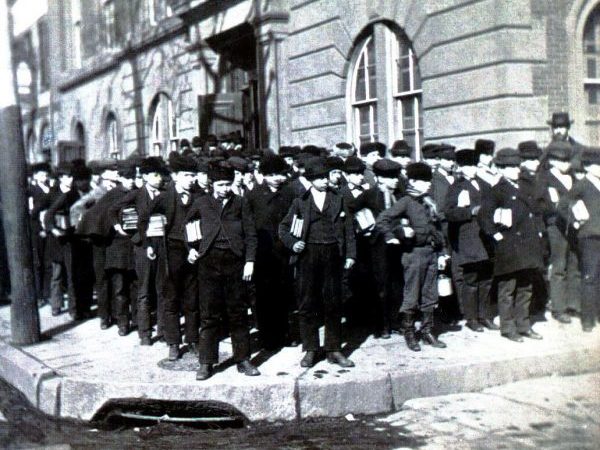
“Rogues on the streets, 11:00 am at school day” (1910)
Today, Holmes’s vision is being realized. Advancing technology that includes digitized images, search and retrieval databases, and the Internet has made it possible for major historical photograph collections to go on-line thus creating searchable data bases of millions of historic images. Sites like the National Archives and Records Administration with more than 124,000 digitized photos are enormously popular. Public libraries in New York City, Denver, and Los Angeles and Historical societies in Minnesota, Oregon, and many other states also maintain online collections, each with hundreds of thousands of photographs. One of the largest sites is the Library of Congress’ “American Memory” As the name suggests, image archives have become a virtual representation of collective memory.[1] The American Memory site describes itself as: …”a multimedia web site of digitized historical documents, photographs, sound recordings, moving pictures, books, pamphlets, maps, and other resources from the Library of Congress’s vast holdings. A historic initiative in its own right, American Memory currently makes available more than 100 collections and more than 9 million individual items to users in the U.S. and throughout the world”… (fuente)
Most of the photographs come from the Library of Congress Prints and Photographs Division, which recently passed the one million mark for digitized images available online. Free and open to the public twenty-four hours a day and seven days a week, image banks have quickly become valuable sources of data for students, scholars, and others preparing lectures, doing research, or just browsing. American Memory receives over 10 million page views per month and over 7 million visits per month. As well as the ongoing project of digitizing their collections, American memory accept donations of new materials, if they are deemed historically significant. Approximately 20% of traffic to the Library of Congress site, not just American Memory, comes from teachers[2]. The site makes a specific appeal to schools: “Let us be your “front door” to more than 100 American Memory collections! Here is a ‘teacher’s eye view’ of over 7 million historical documents, photographs, maps, films, and audio recordings. You will find lessons, features, activities, and tips and tricks for using these collections in your classroom. Please join us”. (fuente)The central question is what is the nature of that memory? The viewer seems confronted by the appearance of history itself, yet photographs cannot be simply accepted, as “proof” of the existence of the object[3] . Visual images are evidence of human productive activity, worked matter, and as such their use and understanding is governed by socially established symbolic codes. Each time a photograph is examined four variables combine to provide meaning: technological capability, photographer’s intent, the image itself, and the perspective of the viewer. In other words, far from being uncontested reflections of reality, photographic images are polysemic social constructions with multiple meanings. The photographer’s intent can frequently be learned or deduced from captions, documentary material, other photographs in a serie, etc. The image itself can be examined from a number of perspectives including the disciplines of semiotics, history, cultural criticism, literature and so on. The goal is to describe as deeply as possible the iconic, indexical and symbolic elements of the image. The intent of the first two investigations is to gather as much evidence of meaning as possible concerning the image in question. The third variable, the standpoint and project of the observer, contributes to the selection and codification of meanings from among those meanings available. Whether, for instance, the viewer focuses on artistic style, symbolic meaning, or historic context — and which of the available meanings is chosen or foregrounded — has to do with the stance and standpoint of the observer.
Evidence – objective, factual, documentary information provided by the photograph or its context (e.g. format, content within the photograph, attribution to photographic studio based on imprint or printed identification from the period, etc.).
Interpretation – deductions built on circumstantial evidence and context that can be clearly verified to and by others (e.g. dating from format or image content, verification of period or more recent written identification, comparison with other known images, etc.).
Speculation – subjective attributions that extend the interpretation based on less concrete evidence, or emotional reaction to the image. (Rowe 2002; Margolis and Rowe 2002).
Historical photographs have typically been used for positivist or narrative projects. Most history books, for instance, contain a photograph section intended to simply reinforce the text. My approach, to the contrary, is hermeneutic, critical and ethnographic. In what follows I will not examine urban schooling systematically in any specific city or historic period, though such approaches are essential (cf Cremin, 1988; Cuban 1993). Instead I will offer a brief survey, incorporating examples of the visual in educational research employing a hybrid mix of methods borrowed from grounded theory, symbolic interactionism, semiotics, and critical theory. In providing examples I will try to be clear about which of these hermeneutic practices is being used, and why. I will examine single images as social constructions but also consider larger projects of individual photographers or institutions. Curious about their use and the social settings in which they are produced and consumed, I also examine the archival practices that preserves some images while leaving others to the pure exchange value of the e-bay auction.
The Image of the Urban School
Photographs offer an important way to look at the history of urban education in the United States. From Jacob Riis’ muckraking in the slums of New York and Frances Benjamin Johnston’s shots in Washington DC schools at the end of the 19th century, through the Farm Security Administrations files of the 1930’s and 40’s, to the documentation of “juvenile delinquency” and racial integration in the 1950’s and counter-cultures in the 1960’s, urban schools have been the targets of photographers. The photographers’ many different agendas reveal much, both about education and about the ways that powerful groups have used education as a trope for a variety of real or imagined social ills. Photographs bring something special to the study of schools. Singly, they spark imaginations. One after another they have a curious additive effect – perhaps something similar to the way the brain merges 24 frames per second into a moving image. Moreover, juxtaposition, montage, doubling and contradiction are wellknown effects produced by the visual experience itself. Even absent written texts and captions, photographs have a way of raising questions. To again quote John Berger (1982:117): “In every act of looking there is an expectation of meaning.”
It is impossible in this short essay either to do justice to the many ways that photographs can be studied or the controversies over photographic meaning. Nor is it possible to do more that provide a brief, but perhaps indicative, survey of images of urban education. I’ll select a handful of images to reproduce and comment on them briefly. There are many things that can be directly observed in school photographs: socially constructed qualities of teachers and students including gender, race, ability/disability, and social class – in this one can also discern degrees of exclusion, segregation, diversity and integration; details of schools as physical plants – buildings, classrooms, the arrangements of desks and so on; arrangements of surveillance and discipline as suggested by Michele Foucault (1995) and John Tagg (1988)[4] ; and elements of 6 the overt and hidden curricula which are often visible. One also learns, very quickly, that no uniform image of urban schooling emerges (C.f. Tyack, 1974:5). What connects images of urban schooling are contradictory and conflicting representations.
My emphasis is on how the image of urban schools has changed over the time. Having said that, I will quickly add that I will not examine the three most common photographic genres which are very much the same today as they were in 1860: sports teams, graduation, and class photographs. In the modern world state education is charged with reproduction of social structures including beliefs and attitudes, political and socio-economic systems, and social stratifications (Durkheim 1961 [1925], Parsons 1959, Giroux 1983). Sports teams reproduce competition and cooperation; graduation is an essential element of the sorting and selecting process of social stratification; the end of term class photograph represents socialization, citizenship, and social bonding. These genres testify that school is one of the most conservative of social institutions, but while extremely resistant to change, it does change.
Nineteenth Century Images
A good place to begin this visual survey of urban schools is with a drawing from Harper’ weekly dated to the 1870’s [5] . It depicts an enormous auditorium. The body language 7 being depicted is best examined through a lens of symbolic interaction (Goffman, 1976). In front, a bearded male teacher stands with his finger on a bell. His raised desk allows him to see each of the students who sit at long benches like church pews. There are windows on both sides of the hall and on the back wall, which is decorated with an American flag and flag bunting. The students are all male and appear to be white and well-dressed; they all about the same age. They wear what today would be called sports jackets and ties or scarfs [6] . The action, the occasion for the drawing, is to demonstrate a fire drill. The students are exiting the rows to the right and left, they march single file toward exits at the front and back of the hall. Fire drills exemplify the Foucaldian sense of “discipline”: “These methods, which made possible the meticulous control of the operations of the body, which assured the constant subjection of its forces and imposed upon them a relation of docility-utility, might be called “disciplines.”” (Foucault 1995:137).

Figure 1: New York City : a fire-escape drill 1877 training the pupils in a public school to effect a quick and orderly exit in case of emergency. Source: Harper’s weekly : a journal of civilization.
The architecture of schools and school rooms, the design and alignment of desks, are additional examples of what Foucault termed the “little technologies of power.” In response to a tap on the bell, the main function of the action is the ceremonial performance of social order, conducted without thought in response to nearly imperceptible signals, a species of “dressage”” (Foucault 1995:166). In this way schools are special examples of Goffman’s “total institutions” the hallmarks of which were “mortifications of the self:” removal of personal possessions, loss of control over your schedule, uniforms, hair-cuts, and the inability to escape from organizational rules and procedures (Goffman, 1961). The institutional goal is to recreate the individual to fit the demands of the organization. The larger function of schooling the body is to shape the it to fit society not just the institution.
The built environment of the city and its attendant social institutions shaped the behaviors referred to as metropolitan or urban culture. While mass transport, high rise buildings, apartments and factories all played a part, schools were among the central institutions disciplining the mind and body. Images of urban schools depict the school in its material form and social organization, but also show how it shaped the kind of behaviors referred to by the educational historian Lawrence Cremin (1988) as “Metropolitanization,” the regimentation of the body and the personality by which schools sought to produce “urban persons.” Many images depict urban schools as highly regimented and disciplined. As Joseph Baldwin wrote in an 1897 book on school management: “When called to the board pupils await signals. At the signal “Board!” each pupil turns to the left. At the signal “attention!” each pupil faces to the right. At the signal “Erase!” the pupils turn to the board and erase by moving erasers down. At the signal “Write!” each pupil takes a crayon and proceeds as directed”. (Baldwin 1897:176).
In lectures on moral education at the Sorbonne given in the 1890’s, Emile Durkheim described the social function of such practices: “It is by respecting the school rules that the child learns to respect rules in general, that he develops the habit of self-control and restraint simply because be should control and restrain himself. It is a first initiation into the austerity of duty” (Durkheim 1961 [1925]:149). Rows and files of pupils, age graded classrooms, established rhythms and cycles of behavior organized by clocks and bells are the little disciplines designed to domesticate the urban individual. Surveillance is provided by the watching teacher with his bell who assigns rank in the form of grades and rewards for performance. As Foucault explained: “the rhythm imposed by signals, whistles, orders imposed on everyone temporal norms that were intended both to accelerate the process of learning and to teach speed as a virtue… (Foucault 1995:154). With each drill, then, children were trained in the hidden curriculum of speed and efficiency and were being prepared to take their places in the metropolitan order.
Alongside the urban disciplines, one of the hallmarks of the metropolitan order is what we have come to call “diversity.” The city encompasses groups of many different races and ethnicities. As everybody knows, these groups are not evenly dispersed but clustered in what the sociologist Herbert Gans (1962) termed “Urban Villages.” Given the local “neighborhood” structure of school catchment areas, this meant (and continues to mean) that U.S. schools are distinctly segregated by race/ethnicity and social class. Thus most school photographs show homogeneous student bodies. But there are exceptions. Figure 2 depicts an ethnically diverse (but apparently homogeneous in terms of social-class) class of students; it comes from an album of nineteen class pictures from the elite San Francisco Girls’ High School taken in 1877. Not only are the young women extremely well-dressed, their teachers sit amongst them. The postures suggest an equality of position in distinction to the teacher’s position in figure 1. Graduates were admitted without examination to the University of California or Stanford University. The school offered three courses of study: Scientific, Latin Scientific, and Classical; the building was equipped with laboratories, an assembly hall, and an art department. Graduates could go on to university or complete the normal course that offered teaching certificates (San Francisco ND).
The crusading Danish American newspaperman and photographer, Jacob Riis, is most well-known today for haunting the back alleys and tenements of New York City with a camera and pan of magnesium flash powder. Many of his photos were reproduced in How the Other Half Lives (Riis 1971 [1890]). One of the first photographic essays, the book focused almost exclusively on the problems of the slums, there are sections on Italians, Jews, Blacks and other immigrants. His photos of children – homeless, delinquent, or doing piecework in windowless rooms – are icons of the progressive movement. However, Riis did not stop with photographing problems, he imag(in)ed solutions. He was a staunch believer in the power of schools to overcome the slum: “The purpose of (The Industrial School) is “to …receive and educate children who cannot be accepted by the public schools either by reason of their ragged and dirty condition, or owing to the fact that they cannot attend but part of the time, because they are obliged to sell papers or stay at home to help their parents.”(Riis 1915 [1892]:189 quoting the report of the Children’s Aid Society)

Figure 2: Mrs. Hunt’s Middle Class. Photographs of Classes in the San Francisco Girls’ High School, 1877. Photographer The A. & A. Lightning Photographic Company Repository The Bancroft Library. University of California, Berkeley.
The Industrial Schools run by the Children’s Aid Society taught “the three R’s” but also cooking, hygiene, sewing, and the other skills necessary to convert desperately poor immigrant children into productive parents, workers, and urban citizens. Riis’s photograph demonstrates how they also functioned to socialize and assimilate:
Very lately a unique exercise has been added to the course in these schools, that lays hold of the very marrow of the problem with which they deal. It is called “saluting the flag,” and originated with Colonel George T. Balch, of the Board of education, who conceived of the idea of instilling patriotism into the little future citizens of the Republic in doses to suit their childish minds. To talk about the Union, of which most of them had but the vaguest notion, or of the duty of the citizen, of which they had no notion at all, was nonsense. In the flag it was all found embodied in a central idea which they could grasp. (Riis 1915 [1892]:204)
Figure 3 was the frontpiece to Children of the Poor (Riis 1915 [1892]). Note the crowded classroom with windows that open onto a brick wall, Riis’s image symbolically represents the progressive view of schooling as a process of Americanization. Although we can make out a desk with a book and school bell in front, two female teachers (or a teacher and teacher aide), and what appears to be an arithmetic lesson on the board, clearly the most important lesson is the diverse group of students saluting the flag [7] . The bell brought them 9 to attention (as in Figure 1), all eyes on the flag, bodies in rank and file, little hands raised in salute, the watchful gaze of the teachers. Here again Foucault helps understand the deeper curriculum beyond reflex patriotism: “Place the bodies in a little world of signals to each of which is attached a single, obligatory response: it is a technique of training, of dressage… .. The training of school children was to be carried out in the same way: few words, no explanation, a total silence interrupted by signals – bells, clapping of hands, gestures, a mere glance from the teacher …” (Foucault 1995:166).

Figure 3: Autor: Jacob Riis. Título: Saludando la bandera en Mott Street Industrial School. Nueva York, c1892. División de Impresos y Fotografías, Biblioteca del Congreso.

Figure 4a.
High school, Albany, N.Y. CALL NUMBER: LC-D4-9579 CREATED/PUBLISHED: [between 1900 and 1910]. Detroit Publishing Co. no. 09579.

Figure 4b.
Boys’ High School, Philadelphia,
Pa. CALL NUMBER: LC-D4-17522
CREATED/PUBLISHED: c1904. Detroit Publishing Co. no. 017522.

Figure 4c.
Hughes High School, Cincinnati,
O[hio] CALL NUMBER: LC-D4-73358. CREATED/PUBLISHED: [between 1910 and 1920]. Detroit Publishing Co. no. 073358.

Figure 4d.
[Central High School, Detroit, Mich.] CALL NUMBER: LC-D4-3384. CREATED/PUBLISHED: [1904?]. Detroit Publishing Co. no. 033384.
Turn of the Century Photographs
In Camera Lucida Roland Barthes (1981:22-26) described two qualities of photographs: “punctum” (which I will discuss later), and “studium” which is informed by a “kind of education (civility, politeness)…” Studium is the socially prescribed, statistically “average,” meaning of interest to the historian and social scientist interested in describing what the image depicts. The Detroit Publishing Company collection at the Library of Congress alone has more than 200 photographs of ornate urban highschool buildings dated between 1900 and 1910 similar to Figures 4a,b,c,d. These images were made to be published as postcards and testify to an outbreak of conspicuous civic consumption that the historian of urban education, David Tyack (1974:56), punned as an “edifice complex.” City schools cost three times as much in 1910 as they did in 1890. Between 1890 and 1918 high school attendance increased by a staggering 711% (Tyack 1974:183). Secular Gothic cathedrals, urban high schools symbolized both the central position of schools in the community and, circulated as postcards, suggested the forward thinking, wealth, and prestige of the city that constructed them.
There are far fewer interior views of urban schools, and fewer yet that show schooling taking place. However there is an extraordinary collection of turn-of-the-century photos of educational activities. One of the most accomplished school photographers was Frances Benjamin Johnston whose unabashedly progressive politics informed her professional eye (Daniel 1974). During six weeks in 1899 she exposed 700 negatives in a systematic study of public schools in Washington D.C. (Kirstein 1966:54). In that project Johnston pioneered techniques depicting progressive educational principles, focusing on active student-centered education and inquiry based learning; she posed many groups of students involved in laboratory experiments, life drawing lessons, sculpture, shop, and home economics; she recorded nature study trips, and visits to museums and workshops. In his positivist history How Teacher’s Taught, Larry Cuban employed Johnston’s photos as a source of data, noticing whether desks were bolted down or movable, and counting and comparing activities. He observed that: “Out of almost 300 prints of elementary school classrooms, nearly 30 show groups of students working with large relief maps in geography, preserved rabbits and squirrels being used for a lesson, students watching a teacher carve into a cow’s heart to show the parts of the organ, and classes taking a trip to the zoo. The remaining 90% of the prints show students sitting in rows at their desks doing uniform tasks at the teacher’s direction” (Cuban 1993: 26).

Figure 5. TITLE: A chemistry lab, Central High School Washington D.C. [1899?]. Johnston, Frances Benjamin, photographer. Library of Congress. LC-USZ62-15542

Figure 6. Black girls in cooking class, washing up. Seventh Division. Washington D.C. [1899?]. Johnston, Frances Benjamin, photographer. Library of Congress. LC-USZ62-26380
Cuban’s description was rather “thin” as opposed to the “thick” description of ethnography (Geertz, 1973). Johnston set out to show what progressive education looked like. She posed teachers engaging in direct instruction, but also students debating, reading and working in groups [8] . In The New Education Illustrated, a self-published collection of Johnston10 ’s Washington photographs, her co-author Edith Westcott made their intent clear: “Our object is … to bring before teachers and parents of children not enjoying such advantages, a presentation of what has been done in a single city as representative of a … feature of Public School Education. The cry of the New Education is for the triple training of hand, head, and heart” (Westcott and Photographs by Frances Benjamin Johnston c. 1900:1).
I selected figure 5 to demonstrate some of the qualities of Johnston’s studies. The modern chemistry lab is well-equipped with Bunsen burners, a sink, glassware, chemicals, and reagents. Well-dressed males and one female student are shown actively engaged in laboratory work while the teacher looks on in the pose that some might characterize as “the guide on the side.” Figure 6 was selected to make the point that Johnston photographed in both Black and White schools, and in ensemble the collection presents a clear view of the segregated dual school system maintained in the Nation’s capital. While the modern viewer will immediately note the difference between chemistry for Whites and cooking and cleaning for Blacks, in 1899 this was considered separate but equal, and education for Blacks was itself progressive. Furthermore, to make her point about progressive educational practices, whether White or Black, she selected upper-middle-class schools. In turn-of-the-century Washington D.C. there were many schools not nearly as well equipped. Many urban high schools today do not have such well stocked labs, and small classes with hands-on individualized instruction have generally been replaced by lectures and video presentations.
Mid-Century Photographs
One of the largest, and certainly the most famous photographic archive is the Farm Security Administration/Office of War Information (FSA/OWI) collection at the Library of Congress. Most of the 164,000 photographs in the FSA/OWI collection are digitized and can be accessed on-line[9] . Although there are more than 3000 photographs of schools in the file, there are very few pictures of urban schools from the FSA phase because the mandate of the Farm Security project, as expressed by Hartley Howe (1940), was: “to make a photographic record of rural America …” Marjory Collins left us photographic documentation that in the 1940’s chemistry classes featuring hands on instruction were part of the high school curriculum for African American students in Chicago. Another arresting was image was made by Edwin Rosskam outside of a “Negro high school” in Chicago. While FSA photographers worked diligently to include African Americans in the FSA/OWI and to depict the special suffering brought on by Jim Crow, the collapse of king cotton, and the great migration north, they did not make a single photograph of an integrated school (Margolis 2005). No doubt this appeased the Southern “Dixiecrats” in Roosevelt’s New Deal Coalition. Edwin Rosskam, who made figure 8, also selected the FSA photographs used to illustrate Richard Wright’s passionate book 12 Million Black Voices. Wright’s poetic narrative takes us beyond the image to reveal the world of these Chicago children’s lives. “We watch strange moods fill our children, and our hearts swell with pain. The streets, with their noise and flaring lights, the taverns, the automobiles, and the poolrooms claim them, and no voice of ours can call them back. They spend their nights away from home; they forget our ways of life, our language, our God. Their swift speech and impatien eyes make us feel weak and foolish. We cannot keep them in school; more than 1,000,000 of our black boys and girls of high school age are not in school. We fall upon our knees and pray for them, but in vain. The city has beaten us, evaded us…”(Wright 1988 [1941]:136)Once the Office of War Information (OWI) took over in 1942, pictures of urban schools appeared in profusion. The intent of OWI photos was purely propagandistic – to portray the war-time ideal emphasizing health, welfare, and patriotism. Well-to-do successful schools were photographed to show a wide range of activities: medical care, lunch, art, theater, music, progressive educational techniques, and modern equipment. In 1943 Philip Bonn made more than 150 exposures in Schenectady, New York including photographs with the titles: “Story reading time in the school library at the Elmer Avenue Elementary School”; “Art class at the Oneida School”; and, “Music class orchestra rehearsal at the Oneida School”. Figure 9 shows a visit from the doctor who gives each child a check-up. Bonn’s assignment encompassing several schools shows prosperous urban school systems (Margolis 2005).
Under the OWI patriotism was highlighted. Indicative of this shift is the fact that before 1942 there was only a single FSA image of saluting the flag while18 shots of pledging allegiance to the flag were taken in 1942-43. War time activities involving urban school children were extensively documented: scrap drives collecting rubber, paper, and metal; buying victory bonds and stamps; learning first aid; and so on. The images intimately connect school children with the local and national community. Figure 10 is typical of many depicting school children conducting scrap drives as part of the war effort.
My favorite photograph from the FSA/OWI collection (figure 11) is different – an enigmatic and atypical image. There are very few photographs of schools for children of the well-to-do in any of the virtual archives [10] . An exception is a group of sixty-four shots 12 from a country day school in Wilmington, Delaware. Curiously, for this well-documented collection, the date is uncertainly put as 1942 or 43 and no photographer is listed. The photos of school work depict child centered and progressive educational practices; children are shown “learning by doing” much like the F.B. Johnston photos from nearly half a century earlier. The one that caught my eye, pricked me, shows six high school girls and a male teacher standing in a muddy city back street. They examine a brick row house; in the background, almost out of the frame, stands a Black man. The caption suggests they are a social science class studying alley dwellings. This photograph stands as a trope for the whole FSA/OWI project. It is as if the whole structure of liberal documentary is being reproduced in this photograph of well dressed, well educated, well-to-do students inspecting the homes of poor people.

Figure 7. TITLE: Washington, D.C. Science class in a Negro high school. CALL NUMBER: LC-USW3- 000881-E [P&P]. REPRODUCTION NUMBER: LC-USW3-000881-E (b&w film nitrate neg.). MEDIUM: 1 negative : nitrate ; 2 1/4 x 2 1/4 inches or smaller. CREATED/PUBLISHED: 1942 Mar. CREATOR: Collins, Marjory, 1912-1985, photographer

Figure 8. Outside Negro high school, Chicago, Illinois 1941 Apr. Edwin Rosskam photographer. Library of Congress. LC-USF33-005150-M1 [P&P]

Figure 9. Schenectady, New York. Each child at the Onieda School is given a physical check-up once a year. The doctor comes twice a week. The nurse is on duty every minute of the day CALL NUMBER: LC-USW3-031454-C. CREATED/PUBLISHED: 1943 June. CREATOR: Bonn, Philip, photographer.

Figure 10. TITLE: Washington Irving High at 15th and Irving Place, New York City, rubber salvage drive. Heeding the request of the President of the United States, high school girls of the Washington Irving Vocational School for Girls bring in the results a treasure hunt from attic to bedroom yielded in their own homes. CALL NUMBER: LC-USE6- D-010438. CREATED/PUBLISHED: 1942 June.
The photograph also illustrates Roland Barthes (1981:22-26) second way that photographs establish meaning: “punctum.” The first form of punctum is “that accident, which pricks, bruises me”. It is punctum that connects photography to art “annihilat(ing) itself as a medium to be no longer a sign but the thing itself…”. Barthes second form of punctum is “time”; it has to do with the indexical quality that directs our attention to that which is not there. Barthes famously called photographs “flat death” — the students and teacher whose image the photographer left with us are not there, but were once. As snippets of time past, punctum makes us aware of our own mortality. For me, at least, figure 11 does that. It also has Barthes quality of studium that makes it an interesting historical image.
During the New Deal and the war years schools began to take on new functions. School lunch programs were implemented both to nourish poor children and to make it easier for mothers working in the labor force. Dentists, doctors, and school nurses were employed to conduct annual physical exams and to provide medical care. Simultaneously the use of aptitude and achievement tests became widespread, as did “scientific” tracking of students into vocational, general, and college preparation programs. Figure12 suggests all of these developments. It is from a small collection of photographs made by the Office of War Information for an overseas traveling exhibition showing the strengths of American schools. Taken in Yonkers, New York in 1943, the photos are in the Library of Congress but have not been digitized. They were clearly propaganda not documentary, posed to make political points, the caption to figure 12 reads: “When children are found not up to par, their mothers are asked to visit the nurse to go over their records to try to find a solution. When a mother realizes her child should not attempt to keep up with the rest of the class, she is at liberty to consult with the nurse.”

Figura 11. Wilmington, Delaware. Tower Hill School, noted country day school for pupils from three to eighteen years of age. Some of the high school pupils of a social science class apparently studying alley dwellings 1942 or 1943?
In the 1950’s and 60’s new sources of anxiety coursed through urban schools. Hydrogen bombs, the cold war, and intercontinental ballistic missiles led to duck and cover drills. The caption to Figure13 reads: “Students of the 5th and 6th grades at Elysian Heights School are shown in a school hallway as they practiced the “take cover” drill. School children throughout Los Angeles County are being briefed on procedures in the event of a national emergency. This is a drill ordered for the school children. Photo dated: October 29, 1962.” We should assume that even more than the fire drill in image one, there were hidden disciplines of obedience and order in these activities. Neither teachers nor students really thought that this would protect against an atomic blast. This photograph bruises and makes me aware of mortality as well; 3000 miles away in New York I was also ducking and covering.

Figure 12. Office of War Information Overseas Branch Exhibit section 52 11 x 14 photos exhibit no. 74a. Schools in Yonkers ca. 1943. Library
of Congress.

Figure 13. “Take cover” drill at Elysian eights School (1962). Los Angeles Public Library.

Figure 14. Board of Education sit-in 1963. Los Angeles Unified School District. Los Angeles Public Library Collection
After Brown v. Board of Education in 1954, not only did civil right movements engulf the entire country, but students took an active part in resisting, confronting, and organizing against schools and school boards (Williams 1987, Giroux 1983). The entire apparatus of pedagogic authority (Bourdieu 1990) was thrown into a crisis of legitimacy. Urban schools were in the forefront of demonstrations for racial integration, bi-lingual instruction, free speech, culturally sensitive and relevant curricula, the repeal of dress codes, community control and more democratic decision making (Munoz 1989). Teachers, students, and parents marched, satin and boycotted schools to bring pressure on school authorities. Groups advocating community control clashed with teachers unions, Whites objecting to integration clashed with federal troops, school busses were stoned, and riots broke out (Blauner 1972; Marable 1984; Williams 1987). All of this was played out in front of cameras. News magazines like Look and Life, local and national newspapers published thousands of photographs showing the turmoil that gripped American schools. I selected figure12, from the Herald-Examiner collection, because it is peaceful, because is shows young students protesting for a social goal, and because Black and White children had channeled resistance into an organized political action (Gitlin 1987) (And perhaps also because it is so similar in composition to figure 13). I especially like the fact that they are doing their schoolwork in what were called “study-ins”. The caption reads: “Sit-in for school integration in the Board of Education hallway on October 24, 1963.” Needless to say many at the time saw these images as symbolizing a breakdown in law and order and as a threat to authority.
Discussion – Modern Times
Somewhere in the 1950’s or ‘60’s, in the popular imagination, schools changed from centers of civic pride, order, socialization and achievement to locations of chaos and social problems (Leo 1997). Juvenile delinquency, sensationalized in such films as Blackboard Jungle (1955) , Rebel Without a Cause (1955) and West Side Story (1961), the racial tensions brought about by racist reactions to integration and massive White resistance, hippies and the drug culture – all played a part in delegitimatization. Each cultural conflict seemed to chip away a little more from the view that youth were malleable and that urban schools could discipline the body and the personality. Whites and the middle class fled the city for the suburbs; they deserted the North and Midwest for the West and the so-called “Sunbelt.” They built “gated communities” and as cities like Los Angeles and New York became “majority minority” cities, some white taxpayers withdrew their children from the public schools and their support for school taxes (Hayes-Bautista, Schink and Chapa 1988). Voter initiatives like the 1978 Proposition 13 in California cut deeply into funding for education (Davis 1990). City schools are now more segregated than they were in 1967.13[11] .
The word urban, that once connoted metropolitan, civilized and sophisticated came to be synonymous with chaos, poverty, danger and violence – “urban decay”, “inner city” and “urbanschools” came to be code words for ghetto (Ferrell 2001; Massey and Denton 1993). As pedagogical authority was withdrawn from schools, metal detectors, cameras, security guards, and undercover police replaced the panoptical surveillance of the teacher (Devine 1995). The last figure I will show is to me a disturbing image. The caption to Figure15 reads: Undercover LAPD officers Dwane White (left), and Yolanda Gonzales appear at a press conference with Chief Daryl Gates, where Gates said the two were among eight undercover agents behind a narcotics operation at nine city high schools. They found 201 students dealing drugs, mostly marijuana, during the 13-week “school buy” program which ended in early April. Officers made 393 purchases, including cocaine and LSD, during the 13-week operation at Monroe, Verdugo Hills, Gardena, Canoga Park, Cleveland, Taft, San Pedro, San Fernando and Hollywood high schools.
Urban schools serve “them” not “us,” they are no longer perceived as mutual institutions, of which Foucault observed:”We have here a sketch of an institution of the “mutual” type in which three procedures are integrated into a single mechanism: teaching proper, the acquisition of knowledge by the very practice of the pedagogical activity and a reciprocal, hierarchized observation. A relation of surveillance, defined and regulated, is inscribed at the heart of the practice of teaching, not as an additional or adjacent part, but as a mechanism that is inherent to it and which increases its efficiency” (Foucault 1995:176).
People in the United States seemed to forget Durkheim’s Maxim that: “The fear of punishment is something altogether different from respect for authority. It has a moral character and moral value only if the penalty is regarded as just by those subjected to it, which implies that the authority which punishes is itself recognized as legitimate” (Durkheim 1961 [1925]: 154).

Figura 15. Undercover officers 1986. Photographer Anne Knudsen. Figure dated: May 21, 1986. Los Angeles Public Library
New eugenicists like Charles Murray (Herrnstein and Murray 1999) recycled the old arguments punctured by Richard Wright back in 1941:
In their classrooms and laboratories they attempt to harness science in defense of their attitudes and practices, and never do they so vigorously assail us as “troublemakers” as when we say that we are “this way” because we are made to live “this way”. They say we speak treasonably when we declare that human life is plastic, that human nature is malleable, that men possess the dignity and meaning of the environmental and institutional forms through which they are lucky or unlucky enough to express themselves. They solemnly assert that we seek to overthrow the government by violence when we say that we live in this manner because the Black Belt which cradles our lives is created by the hands and brains of men who have decreed that we must live differently. They brand us as revolutionists when we say that we are not allowed to react to life with an honest and frontal vision. (Wright 1988 [1941]:130).
Urban schools have come to be seen as utter failures, too expensive, to dangerous, too out of control to fix. In place of edifice envy and charitable industrial schools are proposals to provide publically funded vouchers allowing parents to choose private schools. In this short essay I have given one “reading” of photographs of urban schools. As suggested in the introductory section, photographs are polysemic texts whose meanings cannot remain fixed but have many interpretations. Not only are individual photographic meanings “up for grabs” but I made specific selections from among the thousands of images of urban schools available in the archives. One could tell many other stories: of gender, of sports, of teaching techniques, of specific eras or ethnic groups, or of particular cities and school districts. Hopefully future researchers will continue to develop photographic views of urban education
REFERENCES
BALDWIN, J. (1897). School management and school methods. New York: D. Appleton and Company.
BARTHES, R. (1981). Camera lucida. New York: Hill and Wang.
BERGER, J. & J. Mohr (1982). Another way of telling. New York: Pantheon.
BLAUNER, R. (1972). Racial oppression in America. New York: Harper and Row.
BOURDIEU, P. & J. C. Passeron (1990). Reproduction in education, society, and culture. Newbury Park, CA: Sage.
CONGRESS, Library of (2002). “Special collections in the Library of Congress Farm Security
Administration/Office of War Information Collection.
CREMIN, L. (1988). American education: The metropolitan experience 1876-1980. New York: Harper and Row.
CUBAN, L. (1993). How teachers taught: Consistency and change in American classrooms 1890-1990. New York/London: Teachers College Press.
DANIEL, P. & R. Smock (1974). A talent for detail: The photographs of Miss Frances Benjamin Johnston 1889-1910. New York: Harmony Books.
DAVIS, M. (1990). City of Quartz: Excavating the future in Los Angeles. London/New York: Verso.
DEVINE, J. (1995). “Can metal detectors replace the panopticon?” Cultural Anthropology, 10:171-195.
DURKHEIM, E. (1961). Moral education. New York: The Free Press.
FERREL, J. (2001). Tearing down the streets: Adventures in urban anarchy. New York: Palgrave Macmillan.
FOUCAULT, M. (1995). Discipline and punish: The birth of the prison. New York: Vintage Books.
FRANKENBERG, E., C. Lee & G. Orfield (2003). A multiracial society with segregated schools: Are we losing the dream? Cambridge, MA: The Civil Rights Project, Harvard University.
GANS, H.J. (1962). The urban villagers: Group and class in the life of Italian-Americans. New York: The Free Press of Glencoe.
GEERTZ, C. (1973). “Thick description: Toward an interpretative theory of culture”. The interpretation of cultures: Selected essays. New York: Basic Books.
GITLIN, T. (1987). The sixties: Days of hope, years of rage. New York: Bantam Books.
GIROUX, H. (1983). “Theories of reproduction and resistance in the new sociology of education: A critical analysis.” Harvard Educational Review, 53: 257-293.
GOFFMAN, E. (1976). “Gender advertisements.” Studies in the Anthropology of Visual Communication,3: 69-154.
___________ (1961). The characteristics of total institutions. Etzioni, A., Complex organizations: A sociological reader. New York: Holt, Rinehart and Winston, 313-314.
HAYES-BAUTISTA, D.E., W.O. Schink & J. Chapa (1988). The burden of support: Young Latinos in an aging society. Stanford, CA: Stanford University Press.
HERRNSTEIN, R.J. & C. Murray (1999). The Bell curve: Intelligence and class structure in American life. New York: The Free Press.
HOWE, H.E. (1940). “You have seen their pictures.” Survey Graphic, 236.
KIRSTEIN, L. (1966). “Foreword” and “A note on the photographer”. The Hampton Album: 44 photographs by Frances B. Johnston from an album of Hampton Institute with 33, an introduction and a note on the photographer by Lincoln Kirstein. New York: The Museum of Modern Art.
LEO, C. (1997). “Urban decay: barricading our cities, and our minds.” New City Magazine.
MARABLE, M. (1984). Race, reform, and rebellion: The second reconstruction in Black America, 1945-1982. Jackson, MS: University of Mississippi.
MARGOLIS, E. (1999). “Class pictures: Representations of race, gender and ability in a century of school photography.” Visual Sociology,14:7-38.
__________ (2004). “Looking at discipline, looking at labor: Photographic representations of Indian boarding schools”. Visual Studies,19.
__________ (2005). “Liberal documentary goes to school: Farm Security Administration photographs of students, teachers and schools”. Holloway, D. & J. Beck (eds.), American Visual Cultures. London/New York: Continuum.
MARGOLIS, E. & S. Fram (2007). “Caught napping: Images of surveillance, discipline and punishment on the body of the school child”. History of Education Journal, 36, 2.
MARGOLIS, E. & J. Rowe (2002). “Manufacturing assimilation: Photographs of Indian schools in Arizona.” History of Education, 33, 2: 199-230.
MASSEY, D.S. & N.A. Denton (1993). American Apartheid: Segregation and the making of the underclass. Cambridge, MA: Harvard University Press.
MUNOZ, C. (1989). Youth, identity, power: The sixties Chicano movement. New York: Verso.
PARSONS, T. (1959). “The school class as a social system: Some of its functions in American society.” Harvard Educational Review,29: 297-313.
RIIS, J.A. (1915). Children of the poor. New York: Charles Scribner’s Sons.
_______ (1971). How the other half lives: Studies among the tenements of New York. New York: Dover Publications.
ROWE, J. (2002). Evidence, interpretation, and speculation: Thoughts on Kaloma, the Purported Photograph of Josie Earp”. Main Antique Digest. San Francisco: Board of Education.
SEKULA, A. (1983). “Photography between labor and capital”. Buchloh, B.H.D. & R. Wilkie (eds.), Mining photographs and other pictures: A Selection from the negative archives of Shedden Studio, Glace Bay, Cape Breton, 1948-1968. Halifax, Nova Scotia.
TAGG, J. (1988). The burden of representation: Essays on photographies and histories. Amherst, MA: The University of Massachusetts Press.
TRACHTENBERG, A. (1988). “From image to story: reading the file”. Brannan, C. & B.W. Fleischhauer (eds.), Documenting America, 1935-1943. Berkeley/Los Angeles/London: University of California Press, 43-73.
TYACK, D. (1974). The one best system: A history of American urban education. Cambridge MA/London: Harvard University Press.
WESTSCOTT, E.C. (c1990). Photographs by Frances Benjamin Johnston”. The New Education Illustrated. Richmond, VA.: B.F. Johnson Publishing Company.
WILLIAMS, J. (ed.) (1987). Eyes on the prize: America’s civil rights years, 1954-1965. New York: Viking.
WRIGHT, R. (1988). 12 million black voices. New York: Thunder’s Mouth Press.
[1] – An abridged and edited version of this article was published in Colorado Heritage (Summer 2000 pp. 30-47) Copyright Colorado Historical Society.
[2] – Data based on personal communication with Michelle Rago, Public Affairs Office at theLibrary of Congress, 01/19/2007[3] – This has always been the case because the photographer makes choices about equipment, framing, depth of field, shutter speed. Moreover photographic images are produced in the darkroom where a variety of manipulations are possible. In the digital world of today software like Photoshop facilitates even more the separation of the image from the object.[4] – I have written in much more detail about some of these issues: examining race, social class, gender and ability in “Class Pictures” (Margolis, 1999); conducting Foucaldian examinations of surveillance and discipline in “Looking at Discipline, Looking at Labor: Photographic Representations of Indian Boarding Schools” (Margolis 2004) and “Caught Napping” (Margolis and Fram, 2007); and analyzing images of schooling in the 1930’s and early 1940’s in “Liberal Documentary Goes to School: Farm Security Administration photographs of students, teachers and schools.”[5] – While drawing and etchings are not photographs, they are subject to many of the same issues of interpretation. Most importantly they have the same polysemic quality that makes them mean different things to different viewers.[6] – The historian David Tyack (1974:50) using conventional written texts provided additional data for reading the Harper’s image. He quoted a Scots reporter who, in the late 1860s, visited a similar assembly of five or six hundred pupils in a New York City School and observed “They were neatly (many of them beautifully) dressed, and all scrupulously clean – a point to which great attention is paid in American schools. Any scholar coming with untidy clothes, or with unwashed face and hands, or unbrushed hair, would be sent home at once.”.[7] – Riis noted that “According to its location, the school is distinctively Italian, Bohemian, Hebrew or mixed.” At the Mott Street school in the photo, he observed that Italians were fast crowding out “the Irish element” (Riis, 1915 [1892]:192).[8] –Johnston’s work is unique and no comparable attempt to photograph educational processes has been undertaken to this very day.[9] – “The collection encompasses the approximately 77,000 images made by photographers working in Roy Stryker’s unit as it existed in a succession of government agencies: the Resettlement Administration (RA, 1935-1937), the Farm Security Administration (FSA, 1937-1942), and the Office of War Information (OWI, 1942-1944). In addition, the collection includes photographs produced by other government agencies (e.g., the Office of Emergency Management) and collected from various non-government sources. In total, the collection consists of approximately 164,000 black-and-white film negatives, 107,000 black-and-white photographic prints, and 1,610 color transparencies. … The core of the FSA-OWI Collection consists of approximately 164,000 black-and-white negatives, encompassing both negatives that were printed for FSA-OWI use and those that were not printed at the time (“killed” negatives)” (Library of Congress, 2002. “Special Collections in the Library of Congress Farm Security Administration/Office of War Information Collection.”. I examined the collection in detail in “Liberal Documentary Goes to School: Farm Security Administration photographs of students, teachers and schools” (Margolis 2005).
[10] – I would suggest two reasons for the lack. First well-to-do people have the ability and power to restrict access to the private spaces in which they live and educate their children. Second is the well known “shooting down” effect of documentary photographers being fascinated with the under classes. This can be seen in choice of topics from Jacob Riis in the 19 Century th to Sebastião Salgado in the twenty-first. While no doubt the impulse to photograph children, poor people, and deviants stems from an impulse toward social justice, it leaves the rich and powerful outside the frame.
[11] – “Racial composition in the largest countywide metropolitan districts has become decidedly less white since 1967. Every major countywide district saw more than 10% decline in white percentage from 1967 to 2000-01, with some districts experiencing substantial loss of white students (e.g., Orange County)…. During this same period, black enrollment has grown in every district” (Frankenberg, 2003:60).