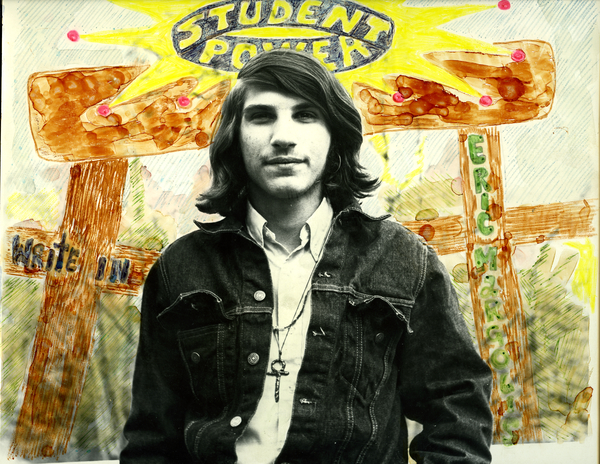
Author: Eric Margolis

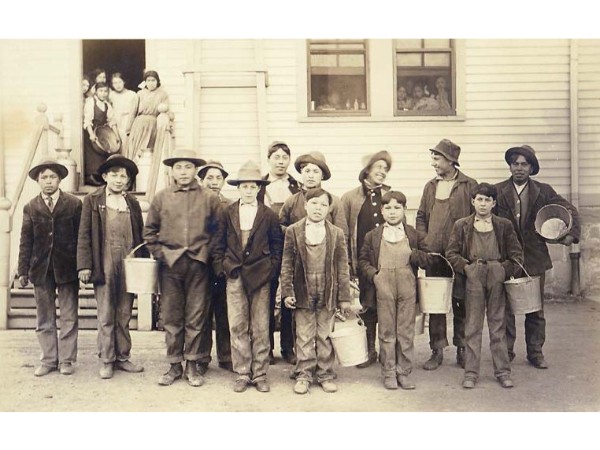
  • Looking at Discipline, Looking at Labor: Photographic Representations of Indian Boarding Schools

    Looking at Discipline, Looking at Labor: Photographic Representations of Indian Boarding Schools

    Eric Margolis is a sociologist in the Division of Educational Leadershipand Policy Studies at Arizona State University. His article, ‘ClassPictures: Representations of Race, Gender and Ability in a Century of SchoolPhotography’ (Visual Sociology Vol. 14,1999) was reprinted in Education Policy Analysis Archives http://epaa.asu.edu/epaa/v8n31/.He has produced visual sociology projects including photography exhibitions,multimedia and video programmes.

    ISSN 1472-586X printed/ISSN 1472–5878 online/02/020085–07 # 2004 International Visual Sociology Association DOI: 10.1080/1472586042000204861

    FIGURE 1. Debating class, Carlisle Indian School, Carlisle, Pennsylvania between ca. 1900 and 1903. Frances Benjamin Johnston Collection, Library of Congress, LC-USZ62-38126.

  • Paradigms, Disciplines and Human Understanding

    Paradigms, Disciplines and Human Understanding

    In this theoretical article, Eric Margolis examines three influential paradigms for understanding education — those associated with Talcott Parsons, B.F. Skinner, and Adam Smith — and argues that each offers only a partial and static explanation for what is fundamentally a dynamic social process. By analyzing these frameworks side by side, Margolis reveals how each reduces the complexity of education to a single dimension: socialization, behavioral conditioning, or human capital formation.

    The article traces how these paradigms have shaped educational policy and practice, often in ways that their original proponents did not intend. Parsons’ functionalism naturalized existing social hierarchies; Skinner’s behaviorism reduced learning to stimulus and response; Smith’s economics transformed education into an investment calculation. Each paradigm, Margolis argues, serves particular interests while obscuring others.

    Moving beyond critique, the article proposes a more integrated approach to understanding education that draws on the sociology of knowledge and the concept of paradigms as disciplinary structures. Margolis argues that recognizing the limitations of dominant frameworks is a necessary first step toward developing more adequate accounts of how education actually works in society.

  • Three Static Explanations for Describing Education: Parsons, Skinner and Smith

    Three Static Explanations for Describing Education: Parsons, Skinner and Smith

    essay on Durkheim and Freire (above). The form of Parsons ' discussions of the functions of education systems is the familiar LIGA "paradigm. "2 In going beyond these general functions, Parsons differentiates four functions of the higher education complex, each of which is conceived of as analogous to an industry. Each function (or industry) has a chapter devoted to it in The American University.

    I. Parsons This essay will examine passages from Talcott Parsons, 1 B.F. Skinner" " and Robert G. Smith as analyses of, or "explanation logics for "education. It will endeavor to show that the explanation-logics are not neutral, scientific or even very descriptive. They assume what they purport to explain; acknowledging them is a political decision—not a "learning of the truth." To Parsons the application of the general Parsonian functional scheme to education, while specifically referenced to the American University, is ' identical in substance to Emile Durkheim s socialization and division of labor functions. In the preface to The American University written by Talcott Parsons alone, Parsons states that he ". . . had long decided that higher education, including the research complex, had become the most critical single " feature of the developing structure of modern societies (1973:VI). While no immediate reason is given for this belief, it becomes clear that it is based on a Durkheim-like analysis of functions which perpetuate the moral community ' and advance the division of labor. Durkheim s assumptions with respect to

    The first industry is the "general education " industry. It forms the base line from which others are differentiated. The second is the research industry which is concerned with enhancing the cognitive capacity. . . . A third is graduate training of the . . . successors of current academicians. 3 A fourth industry . . . (is) the training of practitioners in the applied professions " (1973:5-6). In addition, the university complex also performs a general ideological function which is described as contributing to the "general cultural definition of the situation" (1973:6). However, this role is shared with intellectuals outside the university. The diagram on the next page shows the relationships of each function with the others and with the university complex as a whole.

  • Liberal Documentary Goes to School: Farm Security Administration Photographs of Students, Teachers and Schools

    Liberal Documentary Goes to School: Farm Security Administration Photographs of Students, Teachers and Schools

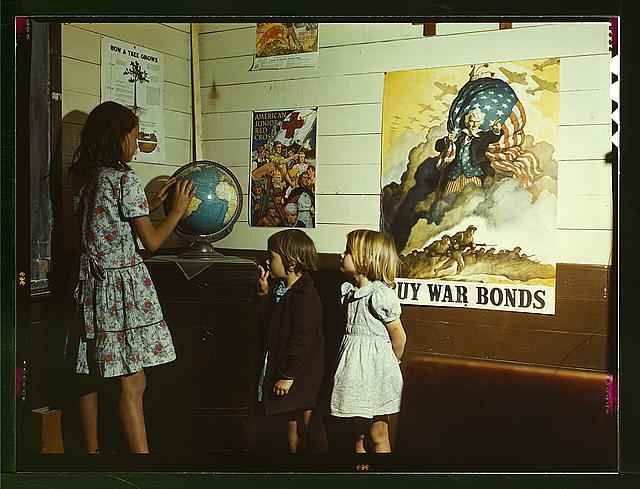
    During the Great Depression, photographers working for the Farm Security Administration produced some of the most iconic images of American hardship and resilience. In this article, Eric Margolis turns his attention to the FSA photographs that documented schools, teachers, and students — images that reveal how education functioned in communities devastated by economic collapse.

    Margolis analyzes these photographs not simply as historical documents but as products of a particular political vision. The FSA photographers were dispatched to build public support for New Deal programs, and their images of rural schools simultaneously documented real conditions and constructed a narrative about the redemptive power of education in times of crisis.

    The article demonstrates how visual analysis can recover meanings embedded in historical photographs that textual sources alone cannot provide, contributing to both the history of education and the methodology of visual research.